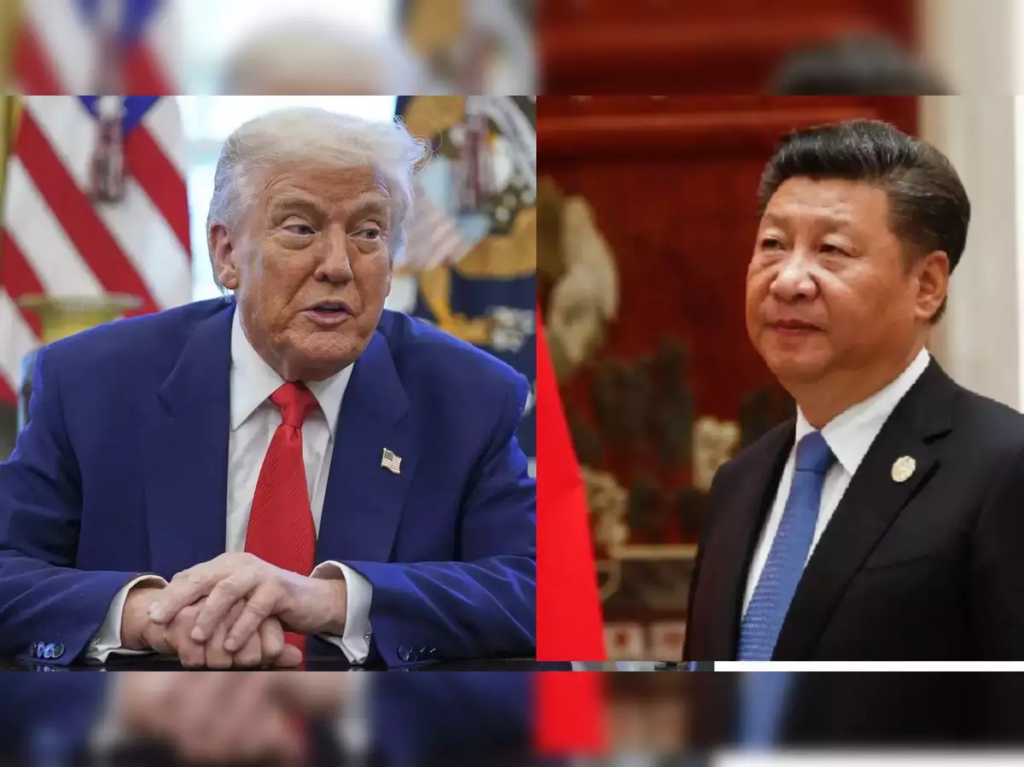
U.S. President Donald Trump has shown the world how to take the Chinese bull by the horn. Within three months of taking over office, he has cornered Beijing in the tariff war and has also taken control of the strategic Panama Canal from China.
Wresting control of the Panama Canal was the first priority of the Donald Trump government. Located in the backyard of America, U.S. naval ships are a frequent user of the canal and 40 percent of the U.S. container traffic uses the Panama Canal route.
Beijing had gained control of the strategic canal through CK Hutchison Holdings, a Hong Kong – based Chinese company with controlling stake in The Panama Ports Company that operated the ports of Balboa and Cristobal on either end of the waterway.
Finally, however, Li Ka-shing, the Hong Kong business tycoon who owns CK Hutchison has yielded to the pressure of Donald Trump and agreed to sell its Panama Canal port assets to a consortium, including American investment bank BlackRock Inc. for a handsome price. For a sum of $19 billion, CK Hutchison will sell 43 ports in 23 countries to the consortium.
Predictably, the deal has irked mandarins of the Chinese Communist Party. Ta Kung Pao, a pro-Beijing newspaper of Hong Kong, has said that the transaction may help the U.S. to control more critical ports around the world and use suppressive measures through the long arm of America, “leaving Chinese ships with nowhere to dock.”
Authorities in China are now trying to put pressure on Li Ka-shing to cancel the deal. Global Times, the mouthpiece of the CCP, has recently called upon “relevant company and individuals involved in selling ports in Panama and other countries to halt the transaction.” According to the Global Times, “Controlling global critical infrastructure is one of the key strategies of the U.S. and ports have become a primary target.”
Ironically, since 2013 it is China which has been gaining control of ports in strategic areas in less developed countries through its Belt and Road Initiative. Unable to pay back Chinese loans, these countries are forced to hand over control of critical assets to China. Now, being paid back in their own coin, the CCP mandarins are not relishing it.
The Global Times has called the deal between CK Hutchison and BlackRock against the national security of China. This makes it clear that China has no commercial interest in Panama Canal but wants to control it for strategic concerns. This vindicates the apprehension that by leveraging the Chinese company Beijing can turn the Panama Canal into a choke point in a conflict.
China has been using BRI as a tool to project its strategic interest. Similarly, China is also bending the rules of fair trade and commerce for dumping. By subsidizing Chinese companies and employing cheap and abundant labour, China has been flooding markets of other countries with cheap products; amassing in the process a huge trade surplus. In 2024 China notched a total trade surplus of nearly $1 trillion. The U.S. was the biggest victim of this dumping of Chinese products, with a trade deficit of $361 billion that year.
Now with the Donald Trump administration unleashing a tariff war against China, this strategy of Beijing, too, is under a stiff challenge. With the U.S. President slapping a 145 percent tariff on imports from China, industries behind the bamboo curtain are reeling. The leadership of President of China Xi Jinping is facing a major test. The New York Times has lately reported from the port city of China Guangzhou that Chinese factories are struggling to survive the new tariffs.”Thousands of export-oriented small factories that have been quick to supply almost any manufactured product at a low cost, using millions of migrant workers employed from all over China, are now faced with cancellations of a spate of American orders,” says the NYT report.
Donald Trump had mentioned on social media about “long term trading abuses” by China. In a recent interview, former U.S. Ambassador to Beijing Nicholas Burns too has explained how China is abusing the healthy norms of international trade and business. “China is a major violator of international rules,” he has said. “The Chinese government has not protected the intellectual property rights of the American companies in China. The Chinese have practiced forced technology transfer. There is a lot of wrong that the Chinese have caused.”
No other country had retaliated against the tariffs imposed on April 2 by the Donald Trump government; except China, imposing a 125 percent tariff on imports from America. The U.S. government has since kept in abeyance the enhanced tariff regime for three months for all countries except China. Different countries have entered into negotiations with Washington. Beijing now runs the risk of being isolated in this tariff war.
“The tariff war with the U.S. will be a major test for Xi Jinping simply because the Chinese economy has not performed well in the last few years. Their GDP growth rate is slowing down,” Nicholas Burns has said in an interview. “They still have a major hangover from the property bubble.”
From double-digit rates of growth for decades, the growth rate of the Chinese economy has now come down to five percent. There is a crisis in the real estate market, the mainstay of the Chinese economy. Foreign Direct Investment is now shunning China. Foreign companies are withdrawing from China. In 2023, the rate of growth of FDI in China was a negative 13.7 percent. Burns says that China cannot stand up to the trade war if it continues for more than six months. Chief China economist at investment bank Macquarie Larry Hu has said the tariffs by Trump could reduce the GDP growth rate of China by two percentage points or more. China had been merrily extending its global power through the control of strategic assets in other countries and dumping cheap products on its trading partners. Like a bull in a china shop, President Donald Trump has upset China’s applecart. U.S. Treasury Secretary Scott Bessant has asserted that Donald Trump plans to project Beijing as “the bad actors.” Trump has written in his Truth Social platform: “At some point, hopefully in the near future, China will realize that the days of ripping off the USA and other countries are no longer sustainable or acceptable.”