The recent India and Pakistan crisis was the most significant between the two nuclear-armed adversaries in several decades. It saw military action unfold that crossed previous thresholds in geographic reach, systems employed, and impacts produced, and concluded with significant diplomatic engagement, primarily by the United States. It also generated unprecedented levels of mis- and disinformation that continue to cloud understandings of what actually transpired between May 7-10. This working paper reviews and assesses the available evidence in order to distill an initial understanding of the conflict’s trajectory—albeit one that will no-doubt evolve as additional information becomes available. Given the unprecedented nature of the military action and the likelihood that this crisis will not be the last between the two sides, such an effort is vital in seeking to build a shared understanding of the Four-Day Conflict.
Executive Summary
Following a terrorist attack on April 22, India launched punitive strikes on Pakistan on May 7. This began a four-day conflict between India and Pakistan from May 7-10, which became the most serious military crisis in decades between the two rival nuclear states. Both sides have declared victory amid considerable misinformation and disinformation about what occurred. This essay seeks to offer a factually grounded narrative of the evolution of the crisis, while mindful of severe data limitation problems in the public domain that complicate analysis. Even with the limited or contested information currently available, some tentative conclusions are possible.
The conflict represents several military firsts:
- This was the first time India used cruise missiles on Pakistan, both the BrahMos cruise missile (co-developed with Russia) as well as the European SCALP-EG.
- This was the first time Pakistan used conventionally armed short-range ballistic missiles on India, in the form of the Fatah-I and Fatah-II missiles and possibly other missile types.
- While drones have been used sporadically along the Line of Control in Kashmir and elsewhere for smuggling, this is the first instance of drone warfare in the India-Pakistan rivalry where both sides employed drones with the intent of causing damage on the other.
Available information also permits several conclusions about the military situation during the crisis:
- India demonstrated an ability to deliver precise standoff attacks across large swathes of Pakistan on each day of the conflict but especially May 7 and May 10. While Pakistani air defenses likely interfered with or intercepted some attempted strikes, Pakistan has a meaningful and serious vulnerability to Indian air attack.
- There is no evidence of any manned aircraft crossing into the airspace of the other side, which indicates the seriousness with which both sides viewed the air defense threat of the other even on the final day of the conflict.
- On the first day of hostilities, May 7, India likely lost several aircraft to Pakistani counterair operations. While Indian officials neither acknowledged nor denied the losses, they represent perhaps the most meaningful military costs India experienced during the Four-Day Conflict.
- On May 8 through May 10, India’s integrated air and missile defense system appears to have largely defeated several waves of Pakistani drone attacks of ambiguous scope, scale, and intensity. On May 9-10, the Indian air and missile defense system appears to have worked against limited Pakistani short-range ballistic missile attacks as well.
- After its apparent downing of Indian aircraft on May 7, Pakistan inflicted virtually no observable damage on Indian military units or facilities, though Indian officials have said there was some damage at four installations.
- While attention focused primarily on the air and drone campaigns, most of the May 7 strikes occurred in or near Kashmir; subsequent fighting along the Line of Control in Kashmir was deadly and served as a major source of casualties for both sides.
Political conclusions are also possible:
- The India-Pakistan relationship remains crisis-prone, and those crises are likely to continue to escalate in severity over time.
- While the mutual possession of nuclear weapons heavily conditioned the responses of both sides, overt nuclear signaling was lower than in many prior India-Pakistan crises.
- Both sides worked to calibrate escalation and showed some ability to manage escalation adequately. Both sides were sometimes surprised, however, by choices made by the other and, in some instances, likely viewed an adversary’s response as escalatory rather than proportional.
- The crisis was costly in terms of human lives and expended or destroyed military equipment. Those costs will likely work to induce some caution in the bilateral relationship in the near-term, a probable principal aim of Indian policy.
- The United States played a major role in crisis management, especially in the final hours of the crisis. While it is conceivable another actor could have played this role as crisis communicator of choice for both combatants, and some alternative third parties did play a role in crisis diplomacy, none of those alternative actors appear to have participated with the same efficacy as the United States.
This crisis involved the use of several weapons systems, often in innovative ways, which neither India nor Pakistan possessed at the time of their last crisis in 2019. While this crisis provides a baseline for the next India-Pakistan crisis, the pace of military technological change means that the contours of that next crisis might be meaningfully different. Both sides’ perceived setbacks and failures will serve as a major driver for defense acquisitions and doctrinal innovation.
An India-Pakistan Near-War in 2025
From May 7-10, India and Pakistan fought a near-war. This essay seeks to offer a first rough draft of history for that conflict, which does not have a settled name.1 Both combatant states have names for conflict: Operation Sindoor for India, and for Pakistan, Marka-e-Haq (“Battle for Justice”) and Operation Bunyanum Marsoos. Yet neither side grants the other side’s name much currency in their own conversations on the crisis.
Some commentators have offered more neutral labels, such as “the 87-Hour War” or “the 88-Hour War.”2 These are good candidate designations for the conflict, barring two problems: (1) the minor disagreement about how long the conflict lasted, and (2) the stricture in political science to withhold the “war” moniker to circumstances where more than one thousand combatants die from fighting. Thankfully, total casualties for both sides—while serious—appear to include less than 200 dead. To correct these deficiencies, I will refer to it as the Four-Day Conflict, since the description is both temporally and taxonomically correct.
Why Care about Another South Asian Crisis?
Whether it meets the academic definition of a war or not, the conflict has earned enormous global attention. It is only the second use of airpower by one nuclear state upon the territory of another (the other example is a much smaller India-Pakistan clash in 2019), and it is only the third example of serious, deadly hostilities directly between two nuclear states (the other examples being the Sino-Soviet clashes of 1969 and the India-Pakistan 1999 Kargil War).3 It thus teaches us how nuclear powers can employ the military instrument under the shadow of nuclear use. Additionally, the crisis underscores that South Asia is one of the most likely theaters for nuclear war, even if that prospect was not imminent in this instance.
The Four-Day Conflict is one of three examples—alongside Ukraine-Russia and Azerbaijan-Armenia—of how modern militaries with high-technology platforms facing foes with near parity might fight wars in the 21st century. Those other conflicts have been highly generative in thinking through contemporary warfare, including in South Asia.
Finally, this 2025 near-war is the first such conflict involving a military (Pakistan) that possesses modern Chinese weapons—notably the HQ-9 air defense system, the PL-15 air-to-air missile, and the J-10 fighter aircraft. The performance of these newer Chinese systems on the battlefield is of immense importance to states that worry about a future confrontation with China. Likewise, their performance matters for a large number of militaries considering the purchase of Chinese equipment for their own defense needs.
Confusion in Crisis: Misinformation and the Fog of War
The chronology offered here is a tentative one that will certainly change with time and new information. Even accepting problems inherent given the fog of war, the data quality challenges in this conflict have been extraordinary.
The crisis has been characterized by exceptional disinformation and misinformation in both social and traditional media.4 The Government of Pakistan has made many claims that cannot be substantiated. Some are plausible (albeit largely unsupported), such as claims of successful attacks against Indian bases or radar systems.5 Others seem fictitious, such as an allegation that an attempted Indian missile attack on Pakistan had resulted in numerous missiles falling short and landing near Amritsar.6
The Government of India has been more restrained in making public claims that it could not substantiate with evidence. Yet India, too, has made plausible (but unsupported) claims such as downing Pakistani aircraft.7 Importantly, India has refused to answer whether the Indian Air Force (IAF) lost planes of its own, though its “non-denial denial” seems to imply at least one aircraft may not have landed safely.8 (India has been clear in stating that no pilots were lost in the conflict.)
These reporting problems have improved since the May 10 ceasefire, but only somewhat. Since New Delhi and Islamabad each declared victory, nationalists on both sides continue to elide problems on their own side, while searching for setbacks across the border.9 Yet eventually outsiders—and hopefully both countries—will have to converge on a consensus about what occurred. This essay is an attempt to advance that effort, with an understanding that like all rough drafts it will have to be rewritten several times.
Crisis Onset: Provocation and Political Context
On April 22, terrorists killed 26 tourists in Pahalgam, in the Indian-administered portion of the disputed territory of Jammu and Kashmir. The attack was especially provocative since it involved a clearly civilian target—a vast meadow that is a known tourist destination—and many eyewitness accounts report a communal nature to the killings, with Hindu males singled out for death.10
The Pahalgam attack occurred as the Narendra Modi government in India sought to restore normalcy to the union territory of Jammu and Kashmir, after major political changes New Delhi undertook to Kashmir’s political status in August 2019. By killing tourists, the attack called into question the success of the Modi government’s Kashmir approach while simultaneously complicating efforts to encourage tighter integration between Kashmir and the rest of India.
Since Modi became prime minister in 2014, there had been two earlier attacks in Kashmir with significant casualties: one at Uri in 2016, which killed 19 soldiers, and another in Pulwama in 2019, which killed 40 Indian paramilitary troops. Both triggered an Indian military response. Most observers, myself included, expected an Indian military response after the Pahalgam massacre.11
As analyst and former U.S. official Joshua White has observed, given Pakistan’s long track record of supporting militant and terrorist groups, most outside governments were willing to accept India’s conclusion of Pakistani culpability, even though the released information tying Pakistan to the group responsible for the attack, the Resistance Front, was scarce.12 (The perpetrators of the attack remain at large.)
The debate after April 22 was not whether India should or would attack, but rather concerned the form and scale of the eventual response. Prior to military escalation, India did take meaningful diplomatic and economic moves to signal its anger. Most notably, on April 23, India placed the Indus Waters Treaty “in abeyance.”13 Pakistan, the following day, signaled that any attempt to divert water would be considered an act of war.14.
Military Hostilities Commence: May 7 Air Strikes
On May 7, fifteen days after the attack, India struck nine sites across Pakistan shortly after midnight.15 India says five of the nine targets were in Pakistan-administered Kashmir with the remaining four in Pakistani Punjab. Of these latter four, two were near the Working Boundary/International Border that separates Indian-administered Kashmir from Pakistani Punjab. Thus, seven of the nine targets were close to Indian-administered Kashmir, and the Indian Army appears to have been responsible for strikes on those targets. It reportedly utilized precision-guided artillery and drone-delivered munitions in those May 7 attacks.16 (Debris consistent with the use of drone-delivered munitions reportedly was recovered by Pakistan on May 7.17)
There were also strikes deeper into Pakistan at Muridke and Bahawalpur that garnered greater attention as attacks so deep into Pakistani Punjab have not occurred since the 1971 India-Pakistan war. Indian press initially spotlighted the use of French-origin SCALP-EG cruise missiles and HAMMER glide bombs in those strikes.18 However, debris reportedly recovered in Pakistan indicates that India also used the BrahMos cruise missile (jointly produced with Russia) in these initial strikes.19
Pakistan claimed 40 civilians were killed in the May 7 strikes, including seven women and 15 children.20 India placed the figure far higher, at “over 100 terrorists,” and did not acknowledge any collateral damage.21 Despite Indian claims, it seems unlikely that a large number of terrorists were present at any of the struck facilities. Pakistan had ample warning of an impending Indian attack, and press reports indicate that Pakistani authorities worked to reduce the number of people in facilities that might be targeted.22
The punitive strikes should be viewed more as a strategic coercive signal rather than an attempt to degrade Pakistan-based terrorist groups directly. In particular, the choice to include two targets in cities (Muridke and Bahawalpur) in the Pakistani heartland of Punjab was a deliberate political signal. Both targets had been linked to anti-India terrorist groups (Lashkar-e-Taiba and Jaish-e-Muhammad) for decades, but their locations were widely perceived as being too sensitive for India to consider striking. By targeting them with airstrikes, India indicated that old geographic safe havens were no longer safe.
While India sought to convey that terrorism in Indian-administered Kashmir could yield retaliation anywhere inside Pakistan, it did seek to show restraint in other ways. An Indian spokesperson emphasized that the May 7 strikes only hit “terrorist infrastructure” and were “focused, measured, and non-escalatory in nature.” Pointedly, Pakistani military targets were not hit.23
Pakistan’s Apparent Counterair Success on May 7
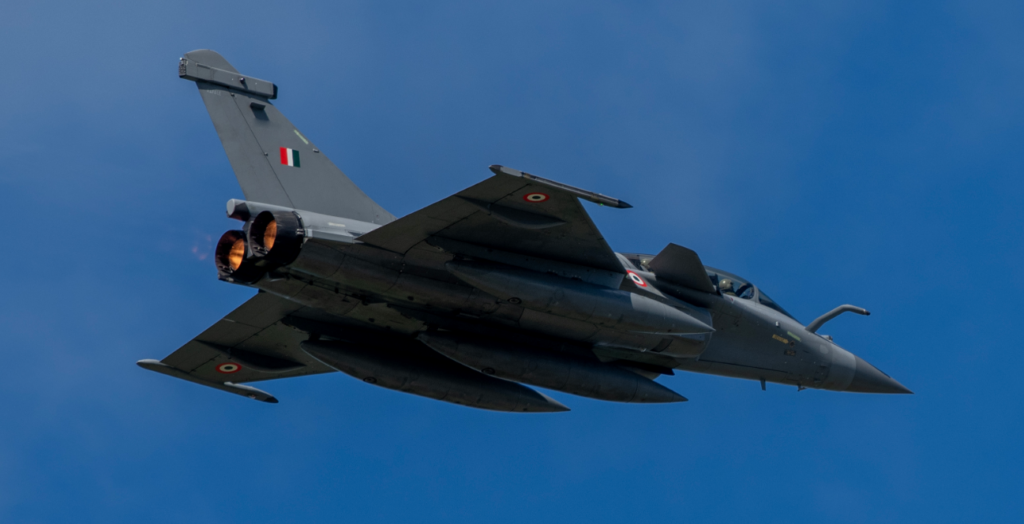
Within hours of these initial Indian air strikes in the early morning of May 7, Pakistan appears to have had immediate success in a defensive counterair operation. The full extent and the causes of that success remain much debated, but Pakistan claims that it shot down six IAF jets on May 7: five over Indian-administered Kashmir and one over Indian Punjab.24
Given unsupported statements in other areas, it is reasonable to question the full extent of Pakistan’s claimed success on this matter. Yet there is substantiating evidence that Pakistan indeed brought down up to four planes.
A Washington Post visual investigation found compelling evidence of three crash sites in India—two in Indian-administered Kashmir and another in Indian Punjab. The Post went further in identifying two of the three crashed airplanes as types not operated by Pakistan, specifically the French Rafale and Mirage-2000.25 Additionally, since there are no reports of either air force operating manned aircraft in the airspace of the other, the presumption is any downed aircraft in India are Indian rather than Pakistani. The Government of India has not labeled any of these crash sites as being those of Pakistani aircraft.
Separately, Reuters reported on May 7 that there were three aircraft downed in Kashmir alone, citing local government sources.26 Since the Post and Reuters reports, video of a fourth alleged crash site has circulated widely on social media.27 Away from the subcontinent, foreign government officials have confirmed to international media that at least one or two aircraft were downed in India in the early hours of the conflict.28
How Pakistan achieved this apparent counterair success is unclear for now. International observers assess IAF pilots as being highly skilled, and several of the downed aircraft are relatively modern – Rafale deliveries to India only started in 2020.29 Indian choices to focus exclusively on terrorist- and militancy-associated targets in the initial May 7 strikes may have contributed to any setbacks.30 A broader Indian campaign to suppress Pakistani air defenses might have caused military casualties and undercut India’s desire to avoid escalation and demonstrate restraint. Political logic and military logic may have worked at cross-purposes.
The exact weaponry used by Pakistan, as well as Pakistan’s operational or tactical choices while employing that weaponry, are poorly understood. In its official briefings, Pakistan has spoken primarily of work it had done to understand the “electromagnetic operational environment” and situational awareness advantages that were conferred during the May 7 engagement.31 Relatedly, some outside observers have speculated that Pakistani success was the result of greater integration of ground- and air-based sensors with frontline fighter aircraft.32
Before the military clashes began, the Pakistan Air Force had previewed its potential use of Chinese PL-15 long-range air-to-air missiles, and the recovery of PL-15 missile debris in India confirms they were used.33 At least one U.S. official told Reuters that the Chinese J-10 was involved in the downing of Indian aircraft, which would imply PL-15 success.34 (The same official pointedly denied involvement of US-origin F-16s.)
For its part, the IAF denies the PL-15s hit their intended targets and points to unexploded PL-15s on Indian soil as a sign of at least some misses.35 It is also possible that some or all downed Indian aircraft were hit not by air-to-air missiles but surface-to-air ones. Indeed, a senior retired Indian Army general has assessed that any aircraft losses are more likely to have come from the Chinese-origin HQ-9 system than the PL-15.36 Moreover, it remains possible that some downings—if indeed any took place—were the result of friendly fire, as fratricide remains a challenge for modern air forces, including India.37 Since many countries may need to confront the HQ-9 and PL-15 in a future conflict, the scope and cause of these potential downings is hardly an issue of purely historic interest and will attract intense scrutiny from militaries globally.
Within the contours of this crisis, May 7 is notable because it could have been a contained event and not the beginning of a longer clash. Indian aircraft might have hit sites across Pakistan as they sought to restore deterrence against Pakistan, but the Pakistan Air Force could have demonstrated its ability to impose costs on those seeking to threaten Pakistan. In this counterfactual, the active hostilities might have concluded that day. Instead, Pakistani leaders apparently calculated that any counterair success on May 7 was inadequate to restore deterrence. The crisis continued.
Escalation in Kashmir: May 7-10
One important arena for subsequent escalation was Kashmir. Since February 2021, a negotiated ceasefire had held on the Line of Control that separates Indian-administered from Pakistan-administered Kashmir (and the related Working Boundary/International Border that separates Indian-administered Kashmir from Pakistani Punjab).38 That ceasefire, already fraying in recent months, collapsed after the Indian air, drone, and artillery strikes.39.
For the remainder of the Four-Day Conflict, these boundaries in Kashmir witnessed intense firing with small arms, mortars, and artillery. Less frequently, tanks and anti-tank guided missiles were employed.40 The militaries refrained from attempting to permanently seize posts or otherwise redraw the Line of Control, but they did attempt to kill each other while still keeping violence somewhat limited. Even in Kashmir, the fighting appears to have largely taken forms present during periods of greater normalcy. Namely, ground forces primarily fought from static, hardened positions occasionally supplemented by small raids.
While Pakistan claimed that some civilians had been killed in the initial wave of strikes, many of the civilian casualties from the crisis appear to have come from firing in Kashmir. For decades, militaries on both sides have resorted to firing on nearby villages in Kashmir during periods of heightened hostilities. That behavior appears to have returned in these clashes.
According to published press reports and my conversations with journalists in the region, more than 50 people died in firing near the Line of Control during the course of the crisis.41 While politically these deaths may have had less effect than the longer-range air and drone strikes after May 7, they make up a substantial source—and plausibly the majority—of total casualties during the near war.
Elsewhere, the crisis only took the form of standoff strikes. According to available reporting, nowhere south of Kashmir along their long shared international border did ground forces exchange fire. While naval forces maneuvered in the western Indian Ocean, their presence was to demonstrate coercive options for the future rather than to participate in hostilities.42 Beyond Kashmir, this would be an air, drone, and missile war.
Drone Duels: May 7-9
The daylight hours of May 7 were marked by comparative quiet. That night (May 7-8), however, Pakistan appears to have begun a drone and missile attack on several locations—the Indian government named fifteen places—in western and northern India.43 These drone attacks seem to have continued into the next night (May 8-9). This phase of the conflict remains intensely confusing because Pakistan’s official military spokesmen repeatedly denied conducting any such attacks until the final night (May 9-10) of the crisis.44
There is unequivocal evidence—videos, contemporaneous eyewitness accounts, and subsequent debris—of Indian air defense (AD) firing both anti-aircraft guns and missiles across the two nights as they responded to what the Indian Director General of Air Operations called a “raid” that sought to “saturate” Indian air defense through “waves” of attacks.45 While I have not found contemporaneous images of drone debris in India from the mornings of May 8 or 9, the Indian government reported by May 9 that there had been several hundred attacks “to test the AD systems and gather intelligence.”46
On May 9, the Government of India named one specific system—the Turkish-origin Asisguard Songar—as being involved in the attack, though they also stated an unnamed “armed UAV” had attempted to target an Army station in Punjab.47 Subsequently, Indian press reported that these attacks were largely composed of “poor quality, basic drones” perhaps serving as flying chaff to clutter radars and probe air defense sites.48 India claimed that these attacks largely failed with minimal damage on the Indian side. The bulk of the evidence, including satellite imagery, supports that claim.
In response to the first night (May 7-8) of drone attacks, India undertook what it framed as a counterattack in the morning hours of May 8. According to an official Indian briefing, the counterattack targeted air defense radars and systems at a “number of locations in Pakistan.” To signal non-escalatory intent, at least to third-party audiences if not unconvinced Pakistani ones, India emphasized that its “response has been in the same domain, with the same intensity as Pakistan.” The result, India assessed, was a “neutralized” air defense radar in Lahore.49
There is overwhelming evidence—videos and subsequent debris—of this attack taking place. India reportedly used a mix of Israeli-origin Harpy and Harop (a newer Harpy-variant) drones.50 Debris consistent with those platforms, as well as British-origin Banshee target drones (likely as decoys), was recovered in several spots across Pakistan.51
Pakistani sources also reported that 11 sites were subject to attack and/or witnessed Pakistani intercepts of Indian drones on that May 8 morning.52 Pakistan’s military spokesmen acknowledged that one of the attacks injured four Pakistani soldiers and caused “partial damage” to equipment, perhaps validating at least in part India’s claim of having neutralized an air defense radar.53 Elsewhere, Pakistani officials claimed a civilian died in the drone attack as well.
Importantly, Pakistan’s public denial of a drone attack on India on the night of May 7-8 meant that the May 8 morning Indian counterattack was not perceived publicly in Pakistan as a counterattack—but rather further Indian aggression. Pakistan’s chief military spokesperson said the attack was a sign that India had “lost the plot,” indicating India was no longer behaving rationally.54 In private, some Pakistani elites complained on that day that their government should have hit back the previous night rather than have invited further Indian aggression.
From India’s vantage, it was merely responding to Pakistan’s counterattack in a calibrated manner. However, even Pakistanis who may have believed Indian claims of a Pakistani drone attack on comparatively small western and northern Indian cities may not have felt that retaliation on targets in Karachi and Lahore—Pakistan’s most and second-most populous cities—was symmetrical and hence viewed Indian behavior as escalatory rather than reciprocal.
The night of May 8-9 appears to have been characterized by a similar and perhaps somewhat larger drone attack by Pakistan on India, with no clear effect on Indian infrastructure on the ground. There also appears to have been another retaliatory round of Indian drone strikes on Pakistan. According to the official Government of India briefing, “armed drones were launched at four air defense sites in Pakistan. One of the drones was able to destroy an AD radar.55 For its part, the Pakistani military claimed it had shot down 48 drones between May 8 evening and midday May 9.56 There is less contemporaneous documentation of this May 8-9 retaliatory drone attack than of the May 8 morning attack.
The fact that the Indian intra-crisis target selection focused on air defense on May 8 and 9 also meant that, with each successful strike, Pakistan would pose marginally less of a threat to Indian aircraft in the event of future, larger rounds of fighting. Hence, the IAF would have more ability to punish Pakistan. Indian senior military leadership have spoken of a cross-service, coordinated “escalation control mechanism” that served as the logic guiding Indian attacks.57
As the deterrence theorist Thomas Schelling argued in 1966, “The power to hurt is often communicated by some performance of it… It is the expectation of more violence that gets the wanted behavior, if the power to hurt can get it at all.”58 The calibrated May 8 and 9 attacks and the wider, but still calibrated, May 9-10 strikes by India appear to have followed Schelling’s logic. The attacks also narrowly served the IAF’s institutional interest in prioritizing suppression of enemy air defenses, an interest especially salient if the IAF did lose aircraft on May 7.
U.S. Nuclear Worries: May 8-9
After the first drone duels, on May 8, Vice President J.D. Vance gave an interview on the conflict where he said, “Our hope and our expectation is that this is not going to spiral into a broader regional war or, God forbid, a nuclear conflict.” The Vice President argued for a policy of diplomacy and distance: “We’re not going to get involved in the middle of a war that’s fundamentally none of our business.”59
Sometime on the morning of May 9 on the east coast, the U.S. view of the conflict shifted because of new “alarming intelligence,” as CNN reported based on conversations with Trump administration officials.60 Around noon eastern on May 9 (9:00 pm in Pakistan, 9:30 pm in India), the Vice President called Indian Prime Minister Modi to express American concerns that “there was a high probability for dramatic escalation as the conflict went into the weekend,” according to administration officials recounting of the episode.
The precise timing of the CNN report is important, because U.S. worries emerged before the dramatic escalation of hostilities on the night of May 9-10. Some accounts, such as that which appeared in The New York Times, suggest that American concerns heightened because of the dramatic escalation, but that explanation appears inconsistent with the CNN chronology.61 The CNN chronology also rules out any Pakistani public statements about the National Command Authority as the source of U.S. worries, since those statements—discussed later—occurred on the morning of May 10.
What might have worried Washington? Here neither the CNN nor New York Times reporting offers much guidance. It is possible Washington observed Pakistani preparations for short-range ballistic missile launches. The Fatah-I and -II missile systems (and perhaps other missile types) were likely employed for the first time on the night of May 9-10.62 With the U.S. intelligence community having observed short-range ballistic missile use repeatedly in recent clashes around Ukraine and the Middle East, it is not clear that preparations of a conventional ballistic missile system alone would have been adequate to jar the U.S. system away from its prior path of more relaxed diplomacy. The United States likely tracks a number of indicators associated with Pakistani nuclear readiness and, in the past, signs of changes to the Pakistani stockpile have spurred U.S. involvement.63 In some prior cases, there is evidence that the Pakistanis sought to signal primarily to the Americans with such moves. If the United States did detect changes in readiness in the Pakistani stockpile on May 8-9, it would indicate such changes could take place in the absence of an announced meeting of the Pakistani National Command Authority.
No doubt the escalation in hostilities on the night of May 9-10 further troubled U.S. officials already fearful because of the earlier shift in U.S. intelligence assessments. Around the time Vance was reportedly talking to India’s Prime Minister Modi on May 9, Pakistan’s military spokesperson declined calls for de-escalation and an end to the crisis. “With the damages India did on our side, they should take a hit. So far, we have been protecting ourselves, but they will get an answer in our own timing.”64
Crisis Climax: May 9-10
The night of May 9-10 was characterized by the climax of the crisis, setting the stage for its rapid denouement. The night witnessed a dramatic escalation of violence, though within the confines of standoff strikes on military installations. While the escalation was unmissable to even a casual observer, the exact sequence and contours of the May 9-10 escalation is arguably more contested and confusing than that of earlier days in the conflict.
Shortly after midnight on May 10 (India time), there appears to have been an air intercept near Sirsa, India, approximately 130 kilometers from the India-Pakistan border.65. Some Indian press accounts suggest this was an Indian intercept of a Pakistani Fatah-II short-range ballistic missile, which has a reported range permitting such a flight.66
In a bizarre and unsubstantiated claim, around 1:45 am Pakistan time, Pakistan’s chief military spokesperson alleged that India had fired six missiles—all of which landed in Indian Punjab (one on the town of Adampur and five on the city of Amritsar).67 There does not appear to be any evidence that this occurred.
One possibility is that Pakistan had decided to launch a ballistic missile attack of its own and was attempting to provide a pretext for escalating from drones to longer-range (though still short-range) ballistic missiles. It is notable in this regard that in the official Indian briefing of the following morning, Indian officials claimed there were “several high-speed missile attacks noticed subsequently after 0140 hours in the night at several air bases in Punjab.”68 Thus, the Indian alleged timing of the missile strike’s onset is within an hour of the Pakistani broadcast of their missile allegation. Another possibility is that Pakistan had some indications of an imminent Indian attack but mistook those indications. Around 2:30 am Pakistan time, India struck the Nur Khan airbase, which is part of the large Chaklala military cantonment near Rawalpindi. The blasts were sufficiently loud to wake residents in the nearby Pakistani capital of Islamabad.
The Nur Khan attack was just one of at least eleven sites struck the evening of May 9-10. As the Indian Director-General of Air Operations Air Marshal Bharti explained in a post-crisis press conference on May 11, following “relentless attacks” by Pakistani drones, Indian leadership concluded it “was time to convey some message to our adversary” through a “strike where it would hurt.”69.
The Indian air marshal described the operation as “a swift, coordinated, calibrated attack” that “struck [Pakistan’s] airbases, command centers, military infrastructure, [and] air defense systems.” Nur Khan, along with Rafiqui, Rahim Yar Khan, and Sukkur were all hit in the first wave of strikes, which was followed, the Indian Air Force said, by strikes at Sarghoda, Bholari, and Jacobabad airbases. India also struck command and control or drone-related targets at Murid and radar sites at Chunian, Arifwala, and Pasrur.
These strikes appear to have been successful. The Indian Air Force, which had been criticized in 2019 for exaggerating the scale of damage in a one-off strike on Pakistan, now went out of its way to release satellite imagery of nine of the 11 sites (no satellite images were released by the government of the claimed attacks on Rafiqui or Murid). Commercial satellite imagery confirms that attacks occurred at most of the airbases named by the Indian Air Force, though I am aware of no commercial imagery validating Indian claims at Chunian, Arifwala, Pasrur, or Rafiqui.70
At some bases, such as Sarghoda and Rahim Yar Khan, India decided to crater runways to temporarily halt takeoffs. (Images of Sarghoda show signs of repair in satellite images captured on May 11.71) At other locations, notably Sukkur, Bholari, and Jacobabad, large hangers were hit that could have housed aircraft, though there is not clear evidence any planes were hit. Overall, Jeffrey Lewis of the Middlebury Institute of International Studies concludes that the struck bases “suffered some damage, but not of the sort that would disable them.”72
There were also rumors of broader strikes—too many to refute in detail. Indian social media accounts were ripe with speculation that one of Pakistan’s SAAB-2000 Erieye airborne early warning and control systems may have been destroyed at Bholari. While plausible, the evidence for this claim is at best suggestive and draws primarily on an interview involving one retired senior Pakistan air force officer twenty years out of service.73
The most provocative rumor purported that India hit an alleged nuclear storage facility in Kirana Hills near Sarghoda as part of a broader effort to signal conventional counterforce capabilities.74 The evidence for this rumor is minimal, derived from social media falsehoods regarding radiation leaks combined with ambiguous video imagery of unknown provenance of a strike in a hilly region. (At least one of the alleged videos in circulation is from another conflict.75) The Indian Air Force has denied it conducted such a strike.76 Sometimes this rumor is also paired with the fact that Nur Khan airbase, which was indeed struck, shares the Chaklala military cantonment with Pakistan’s Strategic Plans Division, which has responsibility for nuclear planning. Yet Strategic Plans Division offices are over a kilometer away.
Was India “knocking on the nuclear door,” as Ankit Panda framed the question?77 In the absence of evidence that there was a Kirana Hills strike, let alone an intentional one, one is left with the implications of the strike at Nur Khan airbase amid the larger Chaklala military compound. India is fully aware of the political implications of striking so close to political and military leadership facilities—Indian Air Marshal Bharti paused after he mentioned strikes on Nur Khan to emphasize, “Mind you: Chaklala is Islamabad.” Yet striking within a few kilometers of nuclear-related military facilities is not the same as attempting to strike those same facilities. India may have been knocking, but it remained several doors away from the nuclear one. Whether those intended signals were understood by Pakistan is a separate question for which current data is inadequate to answer.78
Having perhaps struggled with the counterair environment on May 7, India’s achievement on May 9-10 is impressive by any measure. Details of the operation are still limited, but the Indian Air Force reportedly used a mix of decoy drones and anti-radiation drones, like Harop, alongside an array of longer-range standoff weapons, including cruise missiles such as BrahMos and SCALP, as well as solid-propellant rockets like the Israeli-origin Crystal Maze and Rampage missiles.79 Prior Indian drone attacks may have weakened Pakistani defenses as well, both through direct damage to components and through operational changes that Pakistani air defenders may have taken to reduce emissions and hence vulnerability to anti-radiation munitions.
India’s complex, innovative attack on May 10 appears largely to have overcome Pakistani air defenses. Whatever counterair surprises Pakistan had on May 7 did not appear to have had recurrent success on May 10. There are signs of BrahMos and SCALP debris in Pakistan, perhaps indicating some of the planned strikes did not succeed. The lack of visible damage in any satellite imagery released to date of Rafiqui base may also indicate that that strike did not go as intended. At the same time, an official Pakistan Air Force briefing on May 11—which contained inaccuracies in other claims it made—did specifically highlight success in defending Rafiqui base against Indian attacks.80
We have less of a sense of Pakistan’s goals on May 9-10. Pakistan seems to have increased the firepower in this final night of attacks. If the drone attacks prior to May 9 evening were large, widespread probes, on May 9-10 they seemed to be designed to impose some cost on India. It appears that Pakistan used larger kamikaze drones—in particular, debris of the Turkish-origin Yiha-III, which was not evident on social media before May 10, was widespread once dawn broke.81 It also appears that Pakistan used more short-range ballistic missiles on May 9-10 than it had on earlier nights, and it is plausible that no Pakistani short-range ballistic missiles were used before sundown on May 9.
The Indian Army has claimed to have recovered debris associated with Fatah-I and Hatf-I, both short-range ballistic missiles.82 The intercept above Sirsa would have been beyond the range of either of those Pakistani systems, lending credence to the initial reports that the longer-range Fatah-II was also attempted but intercepted. After the ceasefire was announced on the evening of May 10, the Pakistani military stated it had used the Fatah-I and Fatah-II missiles during the fighting, and Pakistani media posted contemporaneous videos of at least some launches.83
Despite Pakistan’s claims of “major damages” at the 15 airbases it targeted, there is no visual evidence—either from social media photos or commercial satellite imagery—currently available to indicate meaningful damage on Indian facilities.84 Indian officials on the morning of May 10 acknowledged “limited damage” from drone attacks at four locations : Udhampur, Pathankot, Adampur and Bhuj.85 It is possible that a building at an Indian air base at Udhampur shows visible damage, though the available commercial satellite imagery is ambiguous.86 Indian officials in the same May 10 briefing also acknowledged “several high-speed missile attacks… at several air bases in Punjab,” though did not make official statements about the extent of any resulting damage.
It is important to recognize that the Turkish-origin Yiha-III, to my knowledge the largest Pakistani drone for which debris has been identified on Indian soil, has a small warhead—likely one-tenth or smaller the size of the warheads on the Indian BrahMos or SCALP-EG missiles. Just as it is difficult to validate Indian claims of damage against Pakistani radars with Harop drones, it is similarly difficult to validate Pakistani claims of damage with Yiha-III drones.
This caveat does not apply to the Fatah-I and Fatah-II missiles.87 These carry larger warheads more comparable to the BrahMos or SCALP-EG. It would be more surprising if they hit Indian military installations for there not to be observable damage on commercial satellite imagery. Given this, it seems more likely than not that many or perhaps all Pakistani ballistic missiles employed on May 10 were intercepted or they missed. Indeed, some Indian officials have claimed that all Pakistani missiles were intercepted prior to reaching their targets.88
Not all damage is visible from space, though the larger the warhead, the more visible such damage should become. What we can say is that if there was Pakistani-inflected damage on the ground, it was not at a scale that was difficult for the Government of India to suppress. This, then, bounds the range of estimates of potential damage. Indian missile and standoff air strikes, in contrast, created numerous signatures of their success visible via videos and photos on social media, Indian government-released satellite imagery, and commercial satellite imagery. Indian strikes created damage at a scale difficult for the Government of Pakistan to suppress.
One particular claim of Pakistani success deserves close attention. India’s Russian-made S-400 air and missile defense system took on a near mythical status in the crisis. The extent of its involvement in hostilities is unclear. Indian journalists viewed as having close relationships to the Modi government have offered differing accounts since the crisis ended of S-400 involvement during the conflict. While some journalists have suggested minimal involvement, others have said it was used more than ten times and had some success hitting at least one Pakistani aircraft.89 Debris recovered in India and Pakistan appears consistent with S-400 interceptors, however, which would tend to indicate at least some use in the conflict, including attempted intercepts within Pakistani airspace.90
For Pakistan, too, the S-400 became a target of focused attention. Official Pakistani sources claimed that their air force located, targeted, and destroyed an element of the S-400 system at Adampur, in Indian Punjab.91 Indian media reported that the S-400 was targeted by an air-launched Chinese-origin cruise missile but that attack failed.92 Such an attack might be consistent with the Indian official claim that there had been “several high-speed missile attacks… at several air bases in Punjab” in the early hours of May 10. Despite Pakistani military briefers saying there are “loads of pictures” of Indian military targets, none have emerged showing a disabled S-400 component. Available evidence in support of Pakistan’s claim is minimal beyond contradictory obituaries regarding a recently killed Indian serviceman.93 Could Pakistan have struck an S-400 component or another Indian air defense system? Yes, but there is little-to-no supporting evidence in the public domain for such a claim.
How did this asymmetric success come about? It seems likely that Indian air and missile defenses were an important component. The Indian Army had acquired a suite of kinetic and non-kinetic anti-drone systems to complement its existing air and missile defense systems. According to senior Indian Army officers, it explicitly sought to learn lessons from the Armenia-Azerbaijan and Russia-Ukraine wars.94 The army apparently had some success in designing a system and a set of operational procedures capable of minimizing the damage from reportedly large, sophisticated Pakistani attacks.95
No doubt Pakistan also worked to learn lessons from those wars, since many of the drone capabilities it apparently sought to employ in the conflict were recent acquisitions—perhaps only used once before against an adversary with air defenses, in the January 2024 Iran-Pakistan clashes.96 Yet military competition is often a tale of dueling innovations, and India’s drone warfare innovations—on offense but especially on defense—appear to have performed better in battle.
Denouement: Crisis Diplomacy and Ceasefire
What this spasm of violence did do was bring the crisis to a close. Public understanding of the intra-crisis diplomacy is extremely limited, including the conduct during those final hours. Did the Iranian foreign minister pass any meaningful messages during his visit to both capitals at the onset of hostilities?97 Did the Saudi foreign minister do the same in the immediate aftermath of the Iranian visit, or perhaps even hint at any financial carrots for restraint?98 Did China play a meaningful role in encouraging restraint?99 We do not know.
We do know that before military hostilities began, Pakistan named the Chief of Inter-Services Intelligence, Lt. Gen. Asim Malik, as national security advisor.100 This was done to activate the then-dormant channel between Indian and Pakistani national security advisors that had played a role in defusing prior periods of tension. Many have speculated this appointment occurred as a result of outside pressure, perhaps related to U.S. Secretary of State Marco Rubio’s interim appointment as acting national security advisor, which meant he was a counterpart to Malik as well as to Ajit Doval, the powerful Indian national security advisor. The appointment may not have meaningfully shifted subsequent diplomacy, however. Despite initial Pakistani civilian statements that the national security advisors were in contact, Pakistan’s military later clarified that there were no direct talks, while simultaneously suggesting indirect discussions might have taken place.101
We also know that Secretary Rubio stayed continuously engaged, both before and after the worried Vance phone call to Modi on May 9. In the final hours of the crisis on May 9, the Secretary had a phone call with Pakistan’s Army chief, Gen. Asim Munir.102 In the readout of that call, Rubio offered Pakistan an inducement: “U.S. assistance in starting constructive talks in order to avoid future conflicts.”
This seems almost like boilerplate language, so why might it be viewed as an inducement for Pakistan? Since 1972, India has sought for India-Pakistan issues to be resolved bilaterally, even as New Delhi has frequently accepted third-party (especially American) temporary involvement in crisis management (notably in 1990, 1999, and 2001-2002).103 While New Delhi has accepted help in de-escalation and in securing counterterror moves by Pakistan, it has strenuously avoided third-party intervention on the Kashmir dispute.104
The readout of the Rubio-Munir phone call was released at approximately 11 pm on May 9 in Washington, which is 8 am on May 10 Pakistan time, suggesting the conversation must have occurred at least several minutes prior to the press release. It appears that Rubio secured Munir’s agreement to pursue a ceasefire in that phone call or one shortly thereafter with Pakistan’s Foreign Minister Dar, an agreement that he quickly set to work securing.105 This apparent sequence, if accurate, suggests that Pakistan may have had a largely incomplete understanding of any damage it inflicted upon India the previous night since most of these crucial conversations happened long before most battle damage assessments could be completed.
In those final hours, the combination of military escalation alongside U.S. pressure and inducement appear to have led Pakistani leaders to signal that they would cease additional hostilities if India did so as well. Rubio may have pitched this proposal as coming from India, a defensible pose from Rubio since India’s declaratory position after the May 7 attacks was that it would only respond to further Pakistani attacks. Indeed, on their May 10 morning briefing, which began around 11 am New Delhi time, Indian officials stressed, “Indian Armed Forces reiterate their commitment to non-escalation, provided it is reciprocated by the Pakistan Military.”106 Additionally, the Pakistan military may have believed that, with the drone and missile salvos of the previous night already launched, they had done their part to restore deterrence, even if the effects of those strikes may have been poorly understood in Islamabad and Rawalpindi.
The timing of Munir’s conversation with Rubio is important because it may explain another puzzle of the crisis. At 7:30 am Pakistan time, Reuters reported, “Pakistan Prime Minister Shehbaz Sharif has called a meeting of the National Command Authority on Saturday, the military said.”107 This announcement would have been the most overt nuclear signaling of the Four-Day Conflict as the National Command Authority oversees nuclear employment decisions. The puzzle is that by 10:30 am Pakistan time, Pakistani Defense Minister Khwaja Asif declared that no meeting had been scheduled.108 Pakistani leaders likely sought more time to work on a ceasefire directly with India and via Rubio. Indeed, while the timeline is not clear, it is not impossible that the key Munir-Rubio phone call was spurred by the National Command Authority announcement.
As this was occurring, there were several other morning developments taking place around the same time Indian officials were delivering their daily update on May 10, restating India’s offer of reciprocal non-escalation. Around 11:30 am New Delhi time, the U.S. Department of State released a readout stating that Rubio spoke with Indian External Affairs Minister S. Jaishankar on the crisis.109 Separately, Shishir Gupta, a journalist close to the Modi government, reported that, during the phone call, Rubio transmitted Pakistan’s willingness to agree to a ceasefire.110 Jaishankar, according to that same media report, said any proposal must be routed through the established military lines of communication.
The Rubio-Jaishankar phone call appears to have occurred alongside Pakistani director-general of military operations (DGMO) attempts to use an established hotline between military headquarters to contact his Indian counterpart, though available information does not permit a clear sequencing of which call came first. According to a timeline reportedly offered by Indian officials to parliament, the DGMO first attempted a phone call at 9:15 am—more than two hours before the Rubio-Jaishankar phone call readout, but an unknown time away from the diplomats’ phone call.111 The Indian DGMO, Lt. Gen Rajiv Ghai, initially did not pick up at 9:15 am, likely as New Delhi deliberated what he should say. (Officially India claims Ghai was busy in meetings.) According to Gupta, after the Rubio call, India “ignored calls from the Pakistani Foreign Minister and Islamabad’s traditional allies.”112
While not in the official timeline, Gupta has also reported there was some sort of brief conversation involving the Pakistani DGMO at 10:38 am about Pakistani concerns of an imminent attack on Karachi port.113 It is conceivable that conversation involved a lower ranking officer on the Indian side or Gupta incorrectly reported facts associated with the call.
Shortly after noon, New Delhi time, Pakistan’s foreign ministry reiterated the request for DGMO hotline talks via its mission in India’s capital, according to the reported Indian official timeline.114 This message would have been taken as a sign of Pakistan’s urgency. A brief conversation among DGMOs occurred at 1:15 pm followed by a second conversation at 3:30 pm in which a formal ceasefire understanding was reached.
At 7:55 am U.S. eastern time (5:25 pm in India), President Trump entered the conversation. The President announced, “After a long night of talks mediated by the United States, I am pleased to announce that India and Pakistan have agreed to a FULL AND IMMEDIATE CEASEFIRE.”115 A few minutes later, Secretary of State Rubio explained further that “the Governments of India and Pakistan have agreed to an immediate ceasefire and to start talks on a broad set of issues at a neutral site.”116 India announced the agreement to cease fire at around 6pm in India without immediate reference to any other elements mentioned by Trump or Rubio.117
India quickly denied it had agreed to either a “broad set” of issues or a “neutral site.”118 Whether this denial was pre-negotiated—which has occurred in high-stakes diplomacy in the past—or whether the United States sought to make a statement at the fringes of an ambiguous Indian agreement is not clear.119
One might imagine, for example, India agreeing to talks with Pakistan about terrorism and Pakistan-administered Kashmir in their discussions with the United States, and U.S. diplomats opting to frame those concessions in the way most pleasing to Pakistan ears.121 Subsequently, the U.S. president indicated he offered trade concessions as inducements for crisis resolution, something India also denies.122
Given this hazy chronology, do we know why this near-war did not become a war? Even with considerable ambiguity on facts and motives, both sides carefully calibrated their escalation, even when their choices were sometimes viewed as surprising or unanticipated by the other side. When they reached for rungs on the ladder, they may have missed, but they did not inadvertently reach for a rung several above the one they anticipated.
The events of May 9-10 were sufficiently confusing that it likely would have been impossible for either side to be sure “whose turn it was” in this exchange of tit-for-tat violence. Either side would have had cause to press ahead if they so desired. Yet, they apparently did not desire further rounds.
After the sharp escalation of hostilities on May 9-10, the twin combination of military pressure and international persuasion—perhaps combined with Pakistan’s sense that it had struck back and proven its point—was enough for Pakistan to opt to halt the crisis. Pakistani interest is evident in the persistent DGMO calls. Yet, if India truly felt that it had a decisive military upper hand, New Delhi could have opted to press forward. Perhaps it even deliberated doing so. Yet India, too, apparently calculated the political advantages of further strikes were not worth the continued persistence of a costly and dangerous crisis. Both sides accepted the US-facilitated ceasefire.
A ceasefire is not peace, however. The next crisis will come. This crisis will provide the foundation upon which that next crisis will unfold, and so it will be important to scrutinize its lessons and implications before hostilities again erupt.123 This crisis was confusing and surprising. That is why it is important to understand what actually happened with this crisis before the next India-Pakistan crisis comes.