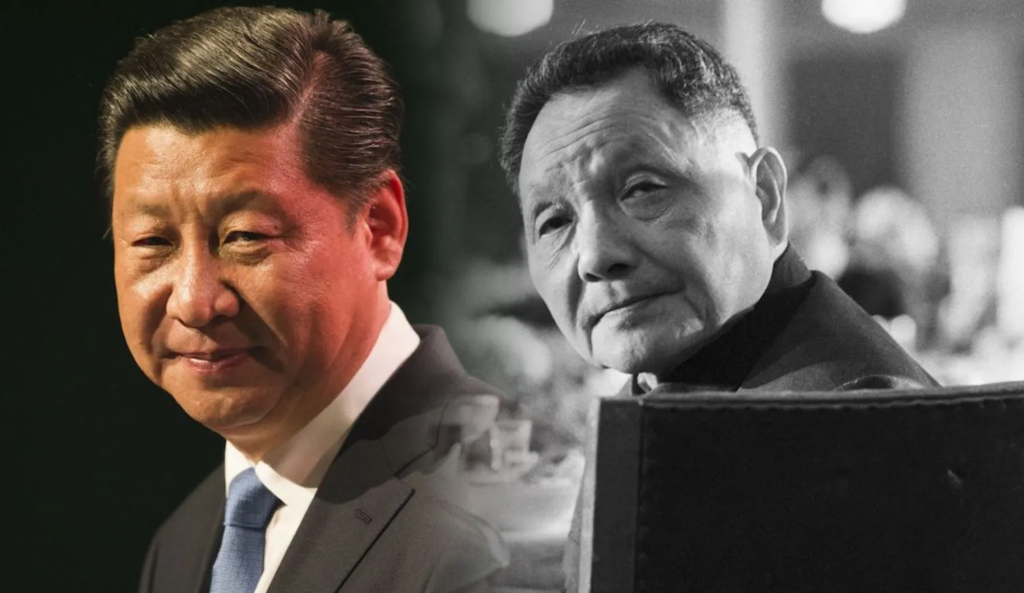
In the face of plummeting growth rates, President of China Xi Jinping seems to have abandoned his “dual circulation” strategy of boosting domestic consumption demand to revive the economy and fallen back on the model of former supreme leader Deng Xiaoping of export-driven growth.
According to a Xinhua report from Tianjin in northern China in late October last year, Xi had emphasized on the importance of state-level Economic and Technological Development Zones of China. Describing these development zones as important for Chinese advancement of reform and opening up of the economy, he emphasized for stimulation in innovation in these zones.
The Economic and Technological Development Zones (ETDZ) of China are comparable with export processing zones in other countries. These designated areas have preferential policies to promote foreign investment and technological advancement. They offer a range of initiatives, including tax breaks and streamlined procedures, to promote business-friendly environments for international companies. As of now there are 54 such national-level ETDZs in China set up by the State Council or the national government, mostly between 1984 and 2002. The state level STDZs are relatively smaller in size and set up by the provincial governments. As of last year, there were 232 of them.
This policy of President Xi is a far cry from his “dual circulation strategy,” espoused in 2020, that emphasized on the domestic economy as the main driver of economic growth, while international trade and investment took a back seat. The “dual circulation strategy” was a move away from the policy initiated in the 1980s, when China had sought to join an integrated and seamless global economy.
In the wake of this course correction, a recent report of the World Bank on Global Prospects indicates the growth rate of the Chinese economy to decline from 4.9 percent in 2024 to 4.5 percent in 2025 and 4 percent in 2026; amid broad-based weakening in domestic demand.
Thus, the “dual circulation strategy” of President Xi Jinping which had sought to steer the economy towards domestic consumption and technological self-reliance, reducing dependence on exports and discouraging foreign investments, has clearly failed. The main reasons being the real estate sector, which was the main driver of the Chinese economy, has not revived and common Chinese people are not confident enough to spend on consumption items.
The Chinese move to turn its back to the world and look inward was an outcome of the policy of President Xi to return to orthodox communism in the days of Mao Zedong, with its deep mistrust of the global economic order dominated by the market economy. Paranoid about interactions with the world economic order and the presence of foreign investors in China that could undermine the political security of the Chinese Communist Party, President Xi had made life difficult for foreign companies operating in China, harassing them with strict data control regulations.
Lately in March this year, five employees of the American due diligence firm Mintz Group were released after two years in detention. Authorities in China detained the five local staff in March 2023, marking the start of a series of raids on foreign consultancy and due diligence firms. China’s National Bureau of Statistics announced later that year that the New York – headquartered Mintz Group had been fined $1.5 million for undertaking “foreign related statistical investigations” without necessary approval; and branded genuine market research as spying. Mintz Group specializes in background checks and investigations into fraud and workplace misconduct.
This release has coincided with a business forum meeting in Beijng that attempted to reassure foreign investors about commitment of China to foreign investment. The detentions, linked to paranoia about national security and espionage, had a chilling effect on foreign sentiments towards China and resulted in a significant decline in Foreign Direct Investment. In the first five months of 2024, FDI in China declined over 28 percent compared to the previous year, the Voice of America has said in a report quoting Chinese Commerce Ministry figures. The instability in government policies in China and the crackdown on several industries to ensure adherence to the government line on political and social issues have discouraged FDI.
Now the call of President Xi to revive the ETDZs is a step prompted by the fall in the economic growth rate to open up the Chinese economy and a U-turn from the previous policy of increased control. The ETDZs are set up in the coastal cities. Great importance is attached to improving the investment environment in these special economic zones. The emphasis is on developing high-tech industrial units, focusing on industrial projects absorbing foreign funds and building up an export-oriented economy. In the past, the ETDZs had become hot places of foreign investment and main infra for export.
A flip side of the policy of achieving economic growth through export oriented units set up in coastal zones is lop-sided development, from which China had suffered in the past. Economic development has been restricted to the coastal areas in eastern China, while western parts of China which do not have ready access to the sea have lagged behind. Of the 54 national level ETDZs in China, 34 are in the coastal regions in the east. To reduce the regional imbalance 21 such ETDZs have been set up in the Middle West region but they have not been as successful as the ones in the east. The regions in the far West, like Xinjiang and Tibet, continue to suffer due to lack of development. But that is not of serious concern for the mandarins of the CCP as these areas are inhabited by the minority communities like the Uighur and the Tibetan. The Western Development Programme of China through investments in infrastructure has failed to reduce this gap between the eastern and the western parts of the country. The east has continued to be more industrialized while the west has remained an area of resource extraction. President Xi thus has no way but to go back to the model of development pursued by his predecessor Deng Xiaoping as the leadership of the CCP would probably be under a stiff challenge if China cannot sustain a high rate of growth in the long run. In the process, China should liberalize and move away from the path of hard core communism which President Xi has been pursuing for the past few years. Goals like developing the domestic sector of the economy and reducing regional imbalance are likely to take a back seat.