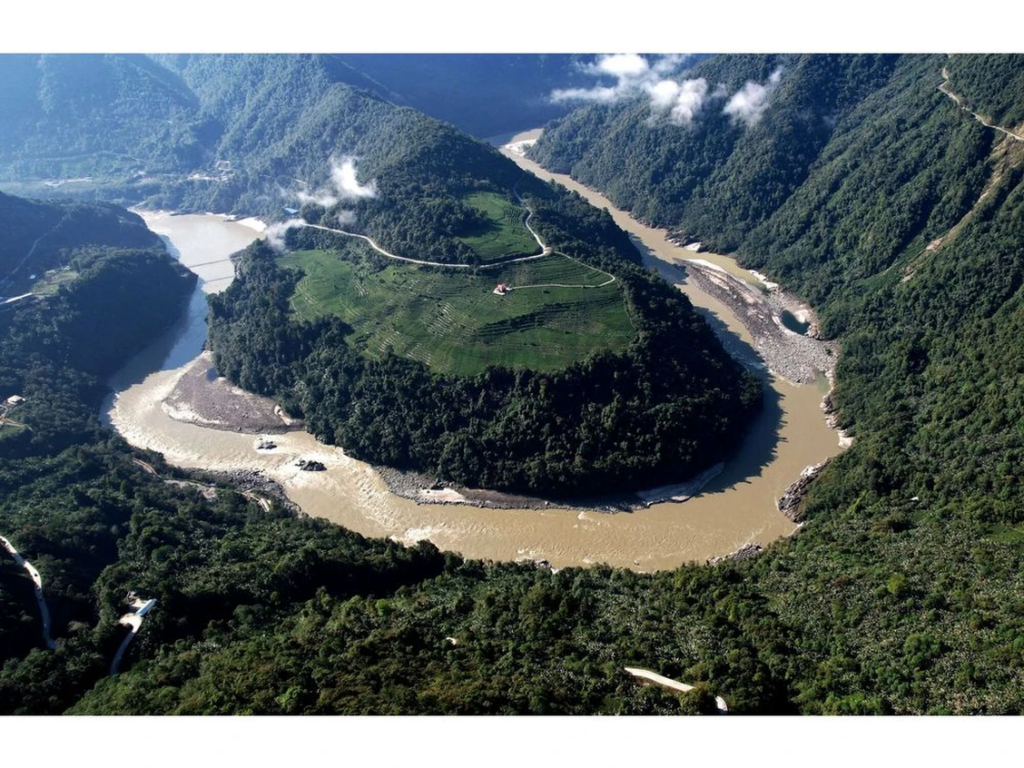
The massive economic stimulus and boost to clean power from a 1.2 trillion yuan ($167 billion) mega-dam in Tibet has proven alluring enough for Chinese leaders to set aside concerns about potential damage to biodiversity and the impact on relations with India.
The massive economic stimulus and boost to clean power from a 1.2 trillion yuan ($167 billion) mega-dam in Tibet has proven alluring enough for Chinese leaders to set aside concerns about potential damage to biodiversity and the impact on relations with India.
Chinese Premier Li Qiang launched construction of the hydropower project, which is three times the size of the Three Gorges Dam, on the lower reaches of the Yarlung Tsangpo river on Saturday. He also unveiled the China Yajiang Group, a new company that will manage the dam’s development, according to the official Xinhua News Agency.
While much is still unknown about the project, its cost alone shows the epic scale engineers are envisioning, with the estimate more than four times larger than the $37 billion that Three Gorges cost upon completion in 2009. That promises an economic jolt for sectors like construction, cement and steel, and a major new source of clean power that could eventually help the country reach its goal of net zero emissions by 2060.
Power Construction Corp. of China and China Energy Engineering Corp. both rose by their daily limit of 10% in Shanghai, while China Energy Engineering’s Hong Kong shares surged as much as 51%. Huaxin Cement Co. more than doubled in Hong Kong before giving up some gains, while Anhui Conch Cement Co. gained as much as 7.6% in the territory. Iron ore, and Chinese commodity futures for steel rebar and hot rolled coil, also climbed.
The project carries risks, as well. The dam could become a source of tension between China and India, as the Yarlung Tsangpo runs through the state of Arunachal Pradesh in northeast India and feeds into the Brahmaputra River, which then flows into Bangladesh.
India formally “registered its concern with China” last December, the country’s External Affairs Minister told lawmakers in March, adding that the project figured prominently in discussions between the two nations in January.
The groundbreaking on Saturday comes at a complicated moment in the relationship between the world’s two biggest countries. Bilateral ties have stabilized somewhat after a four-year stalemate over a June 2020 border clash that killed some 20 Indian and at least four Chinese. Beijing appointed a new ambassador to India in 2024, and earlier this year the countries agreed to resume direct flights and facilitate visa processes.
Still, many points of tension remain. India is looking to position itself as Asia’s main alternative to China as a manufacturing hub, and its closer relationship with the US in recent years is fueled in large part to counter Beijing’s influence in the region. New Delhi maintains investment restrictions on Chinese companies moving into the country, and Chinese companies recently began pulling staff from some factories in India.