Headline PMI stalls in August, with overcapacity and weak domestic demand weighing on the economy
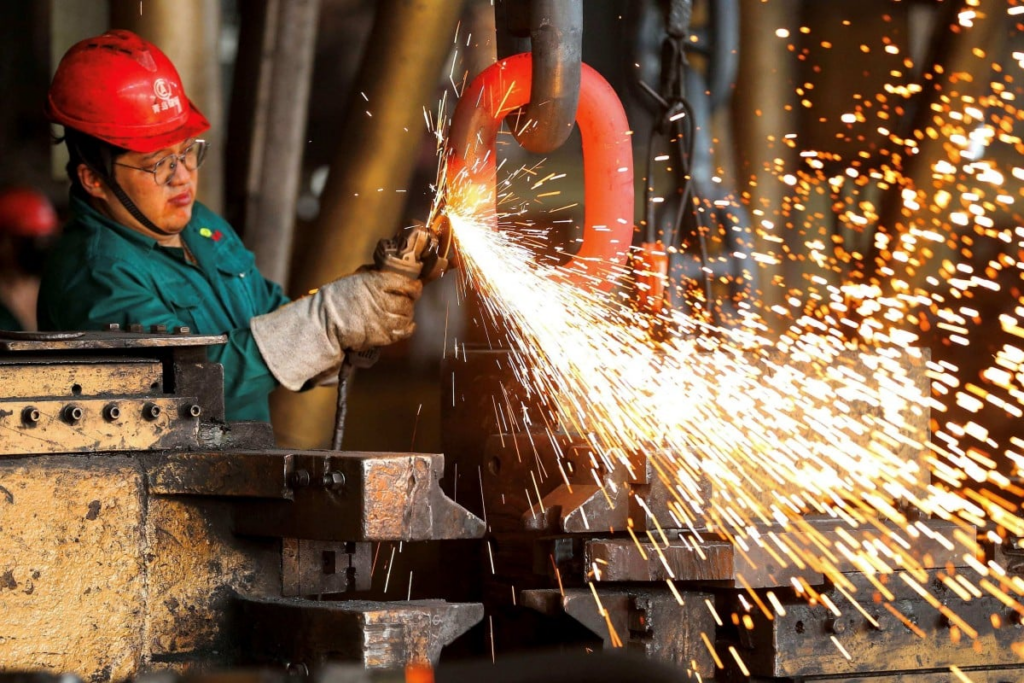
China reported sluggish factory activity in August, as fresh US tech curbs threatened to undermine Beijing’s push into advanced manufacturing.
The National Bureau of Statistics said on Sunday that the official manufacturing purchasing managers’ index (PMI) for August was 49.4, edging up from 49.3 in July.
The headline reading has remained below the 50-point mark that separates expansion from contraction since April, as strains persist in the industrial sector.
The non-manufacturing measure of activity in construction and services rose to 50.3 from 50.1 last month, according to the bureau.
The data highlights the pressure on China’s manufacturing sector, which is weighed down by weak domestic demand, and an ongoing crackdown on cut-throat competition and overcapacity.
Zhang Zhiwei, president and chief economist at Pinpoint Asset Management, said the macroeconomic outlook for the rest of the year “largely depends on how long exports can stay strong and whether fiscal policy will become more supportive in [the fourth quarter]”.
Meanwhile, Beijing’s push for advanced manufacturing and technological self-reliance faces fresh obstacles, as Washington tightens restrictions on chipmaking equipment destined for Chinese plants.
The Trump administration said on Friday that it would revoke waivers for South Korean chipmaking companies Samsung and SK Hynix, as well as Intel Semiconductor (Dalian) to use US technologies in their Chinese operations.
This will limit China’s efforts to make advanced chips and its access to certain technologies.
China’s Ministry of Commerce said it firmly opposed the decision.
“Washington’s move is motivated by self-interest and an attempt to weaponise export controls, which will have a significant negative impact on the stability of the global semiconductor supply chain,” the ministry said.
It said the semiconductor industry was highly globalised and integrated, and urged the United States to “immediately correct its wrongdoings and safeguard the security and stability of global industrial and supply chains”.
“China will take necessary measures to resolutely protect the legitimate rights and interests of its enterprises,” the ministry said.
Samsung Electronics and SK Hynix lean heavily on China for their global memory chip output.
Samsung runs the world’s biggest NAND flash plant in Xian, while SK Hynix took over Intel’s NAND facility in Dalian and has a major DRAM operation in Wuxi. NAND chips are used in USBs and DRAM technology is used in various computing devices.
The chips made in these plants are critical components in smartphones, servers and other consumer electronics assembled in China and shipped worldwide. In the longer run, Washington’s move to revoke their waivers could stifle their ability to import advanced US tools, delaying technology upgrades and expansion.
Despite the US trade war and a series of domestic challenges, the Chinese economy has mostly proven resilient, reporting 5.3 per cent growth in the first half of the year.
China’s trade surplus also continued to widen in the first seven months, as a surge in exports to Southeast Asia and other markets offset a decline in shipments to the United States.
But economic headwinds are expected to intensify in the second half, with business and consumer confidence still subdued, household spending sluggish, and deflationary pressures mounting.
In August, a sub-index for new manufacturing orders came in at 49.5, 0.1 points up from July, pointing to slightly accelerating demand.
Meanwhile, the gauge for new orders in the non-manufacturing sector stood at 46.6, up from 45.7 in July, suggesting an expansion in service activity.
China’s official composite PMI – which tracks both the manufacturing and services sectors – was 50.5 in August, compared with 50.2 in July. A reading above 50 reflects expanding business activity.