Globalization is dead, at least that’s the verdict of a seemingly endless stream of commentators. But as ever in economics, the story isn’t quite so simple. The prevailing account runs something like this: tariffs first introduced by President Trump, kept in place by President Biden and now turbocharged in Trump’s second term, signal a new age of economic nationalism.
According to this view, we are witnessing the start of a grand retreat from the open trading system that has defined the past few decades. The world is turning inwards, and the era of global integration is drawing to a close. But this story doesn’t sit comfortably with the facts. Far from collapsing, global trade volumes have continued to rise and today sit near record highs. If this is the dawn of deglobalization, it is a curiously open one.
Of course, there’s an opposing view that globalization is a kind of economic gravity: resist it as you might, it is an immutable force. From this perspective, the current political squalls are just that – temporary disruptions to an irrepressible trend. Give it a decade, and the world economy will look much as it does now.
This, too, feels complacent. History tells us that globalization has always come in waves, and that those waves break. The golden age of free trade in the late 19th century gave way to the First World War and the interwar collapse. The integration of the post-war period eventually hit the buffers of the 1970s. And today, something is shifting again – not in trade volumes alone, but in the political architecture that underpins them.
Return of geopolitics
The defining force in the world economy today is a deepening superpower rivalry between the United States and China. While Trump’s election in 2016 marked a break with the post-Cold War economic consensus, the true inflection point came earlier – between the 2008 global financial crisis and Xi Jinping’s rise to power in 2012.
Until then, it was still possible to believe that global integration was helping to spread prosperity and liberal values around the world. But the global financial crisis exposed the fragilities and inequalities that had built up during the boom years and globalization quickly became a scapegoat.
At the same time, Xi showed it was a mistake to believe that economic integration would foster the spread of common values. His overriding goals have been to consolidate party control in domestic life and elevate China as a global superpower and challenger to US hegemony. China’s economic policy has changed to accommodate these objectives.
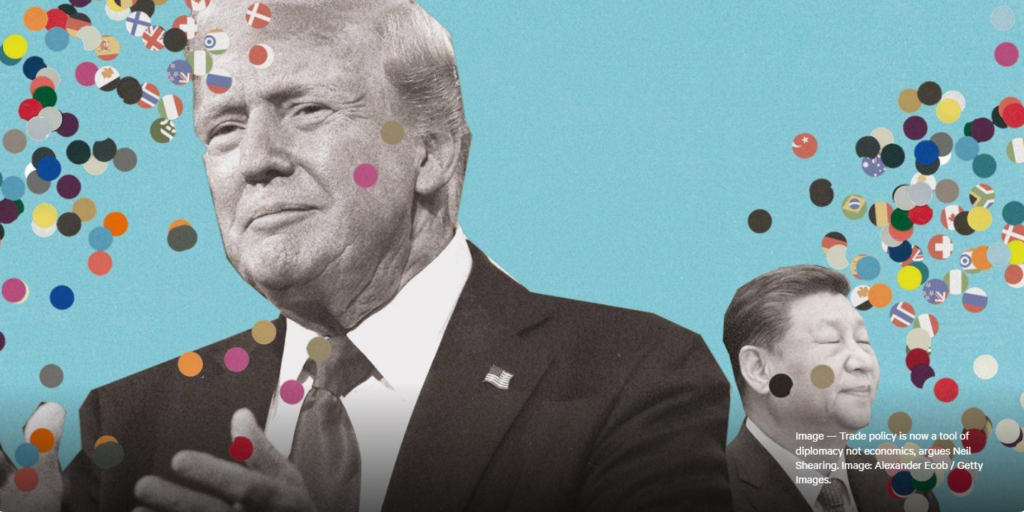
Step back from the heated rhetoric over tariffs, and a broader pattern is clear. Whether in Washington or Beijing, economic policy is increasingly being shaped by geopolitical and strategic interests. That shift began before Trump, continued under Biden and carries into this second Trump administration. Moreover, other countries are now being drawn into this intensifying rivalry.
The result is that the integrated global economy of the post-Cold War era is splintering, giving way to a more fractured world of competing economic blocs centred on the US and China. The economic consequences will be shaped by two factors: what form this fracturing takes and how other countries choose to align.
Impacts on trade
Fracturing is not the same as deglobalization. What we are seeing is not a collapse in trade, but a redirection of it. Apple’s move to shift iPhone production to India – outside the reach of US tariffs and export controls on China – is a case in point. Trade flows are not shrinking , they are changing.
But this is about more than just trade. Beijing’s restrictions on rare earth exports show how strategic control over critical minerals is now a form of economic weaponry. Meanwhile, the Trump administration’s ‘America First’ investment agenda – with its explicit objective of attracting capital from allies while limiting flows from China – highlights how cross-border finance is increasingly subject to geopolitical interests.
So far, the focus has been on safeguarding supply chain security, national security and technological leadership. If that remains the case, fracturing will hit some parts of the global economy far harder than others. Products that contain high-tech components, such as the phones we use and the cars we drive, are highly exposed, as are pharmaceutical products and ‘dual use’ goods that have both military and civilian applications. At the same time, however, large parts of global trade in non-strategic goods – toys and games, white goods and furniture for example – may remain relatively unaffected.
The EU is no third option
Another key question is how countries align. In a fractured world, friends matter. US efforts to restrict China’s access to advanced semiconductors have required cooperation from firms and governments in Japan, the Netherlands, Taiwan and South Korea.
Some argue that Europe could form a third pole in the global economy, around which other liberal democracies might coalesce. This is possible but unlikely.
The European Union accounts for about 18 per cent of global GDP when measured at market exchange rates, comparable to China’s share (17 per cent) and second only to the US (27 per cent). Britain accounts for another 3 per cent. Similarly, while Europe’s population is smaller than China’s, it is a little larger than the US. The EU is also the world’s second largest exporter as well as being its second largest import market.
But economic heft alone doesn’t make a superpower. Europe may be the only region with an economy to match the US and China, but it is still a collection of sovereign states that often struggles to speak with one voice. It doesn’t project its values on to others to the same extent as the US and China. Europe has followed, rather than led, the fracturing process, typically siding with the US – for example, in cutting Huawei out of its 5G infrastructure – but also mindful of its links to China.
Europe tends to move slowly, seeking both consensus in decision-making and a middle ground rooted in a rules-based global system. These are laudable qualities, but they sit awkwardly against the new geopolitical reality and are reasons why a third bloc centred on Europe is a less likely outcome.
While most countries would prefer to remain neutral – and some will successfully straddle the two blocs – it will become increasingly difficult to do so over time. Most governments lack leverage. This constraint is seemingly reflected in recent US trade agreements with the UK and Vietnam, which were reported to include provisions designed to cut out Chinese suppliers in strategically important areas in the case of the UK, and to limit Chinese rerouting of exports in the case of Vietnam.
Similarly, a central feature of the recent US–EU trade deal, thrashed out at Trump’s golf course at Turnberry in late July, was a European commitment to spend around $750 billion on energy products from the US over three years, which would decrease the EU’s reliance on Russian energy.
Neutrality may be appealing, but the ability of other governments to act independently of the US or China is limited. The US is starting from a position of strength. Its traditional allies include: high-income knowledge economies such as the UK; cutting-edge manufacturers such as Taiwan, Korea, Japan and Germany; low-income manufacturers such as Vietnam and Mexico; and major commodity producers such as Canada and Australia.
In contrast, China’s allies tend to fall into one of two camps: autocracies or commodity producers – and frequently both. This will give China an edge over the US in securing supplies of critical minerals, including those needed for the green transition. But it leaves the US with a broader, more adaptable base – and a potential edge in technology.
The real danger for Washington is that its aggressive stance – slapping tariffs on friends as well as foes – is pushing allies away and fracturing the US-led bloc.
Treating partners as adversaries risks undermining the very unity the hawks in Washington need to counter China’s rise. If pursued in full, far from reinvigorating economic growth, the more extreme elements of Trump’s nationalist agenda could reduce America’s GDP growth to less than 1 per cent a year. In this case, ‘America First’ would really mean ‘America Last’.
Where do we go from here?
Much remains uncertain about the form global fracturing will take, but the path we end up on will be determined by three things: whether America remains the leader around which the rest of the West coalesces; whether fracturing can be contained to sensitive areas; and – heaven forbid – whether an ever-deepening rivalry causes the two sides to go to war.
The dream of a benign, rules-based order in which countries trade freely, grow rich together and converge politically now looks hopelessly idealistic. Instead, we are entering an era where power matters more than process, and where trade policy is a tool of diplomacy, not economics. This will be uncomfortable for governments and disorienting for businesses that grew up in a borderless world. But wishing it away won’t help. The job now is to adapt – and fast.