ates seeking jobs at private enterprises is declining, dropping to 12.5% last year from 25.1% in 2020, the survey showed.
Rising uncertainty in the jobs market, layoffs and slowing wage growth in the private sector have pushed many youngsters to seek the “security, predictable benefits and social prestige of public service,” said Mingjiang Li, associate professor at S. Rajaratnam School of International Studies in Singapore.
China’s education ministry has sought to bolster employment at privately owned enterprises, offering tax rebates, social insurance reliefs and subsidies to encourage hiring young graduates. But the incentives have been low. The Shanghai municipal government, for instance, offers just 1,500 yuan in one-time subsidy per new hire.
Government hiring slows
Applications for public sector jobs surged, but openings are hardly keeping pace as local governments are struggling to expand headcounts, making civil service roles harder to come by.
Fiscal strain from the property slump has left many local governments “cash-constrained and reluctant to add staff,” said Jianwei Xu, senior economist at Natixis, noting that “government hiring, after a period of expansion, has now flattened,” making competition fiercer.
The new openings at government agencies jumped 66% in 2020 from a year earlier amid rising demand for public workers to enforce pandemic-induced lockdown and related efforts. But for 2026, the central government trimmed the headcount by 4% to 38,119.
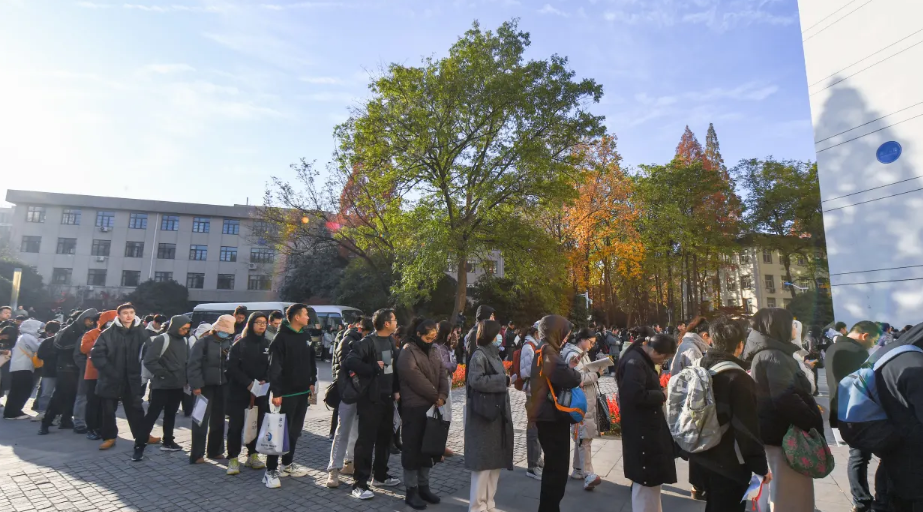
Thus competition has become increasingly brutal: one in about 100 candidates will get hired next year, compared with one in 70 in 2023. The application-to-acceptance ratio for certain posts in rural area where jobs are already scarce was a staggering one in 6,470 applicants.
“The competition ratio in some provinces now rivals the world’s most selective universities … quietly becoming one of China’s most competitive national sporting events,” said Han Shen Lin, a professor at New York University Shanghai.
A record number of college and vocational school graduates — some 12.7 million — are entering the job market next year, set to make the race even fiercer.
As part of the push to absorb more employment, Beijing raised the eligibility age cap by three years to 38 for those with postgraduate degrees and 43 for those with PhD degrees, further increasing the candidate pool.
But still, “a significant share of the openings is being reserved for new graduates,” said Shan, estimating that about 70% of new hires this year were graduates, up from less than 40% in 2019.
Better work-life balance
The surging demand for public service jobs is also the result of an increasingly disillusioned young population losing faith in private enterprises and attaching greater importance to work-life balance, experts say.
“More people are finding appeal in what they call ‘lying flat’ within the government system,” said Shan, referring to the internet catchphrase where people drop out of the rat race and doing the bare minimum to get by. “Of course, whether it’s really like what people imagine is another question.”
Many who successfully land government jobs find the rigid bureaucracy stifling, career advancement can be slow and gets more political the higher one climbs, said Neil Thomas, a fellow at Asia Society Policy Institute’s Center for China Analysis.
“This is hardly unique to China, but increasingly pronounced,” he added.
Diminishing value of higher degree
Meanwhile, fewer students are betting on postgraduate studies. Candidates for the national postgraduate entrance exam that took place in October fell to 3.4 million, according to the education ministry, from a peak of 4.74 million in 2023, reflecting waning confidence in advanced degrees improving job prospects.
“The return on a graduate degree appears to be diminishing … the imbalance has led to a relative devaluation of the degree itself,” said Xu, adding that many students no longer see an extra 2-3 years of study as a guaranteed path to better employment.
The Zhilian Zhaopin survey told a similar story. Vocational college graduates enjoyed stronger job prospects, with employment rates rising to 56.6% last year. Postgraduates, meanwhile, saw their chances deteriorate, with fewer than 45% landing offers, down from nearly 57% in 2023.
Economists warn that an increasing share of top university graduates clustering in the public sector rather than pursuing entrepreneurial or high-risk private-sector paths could weigh on longer-term economic growth.
“Over time, this trend could reshape China’s talent landscape by strengthening the state bureaucracy’s human-capital base while reducing innovation dynamism in the private economy,” RSIS’ Li noted.