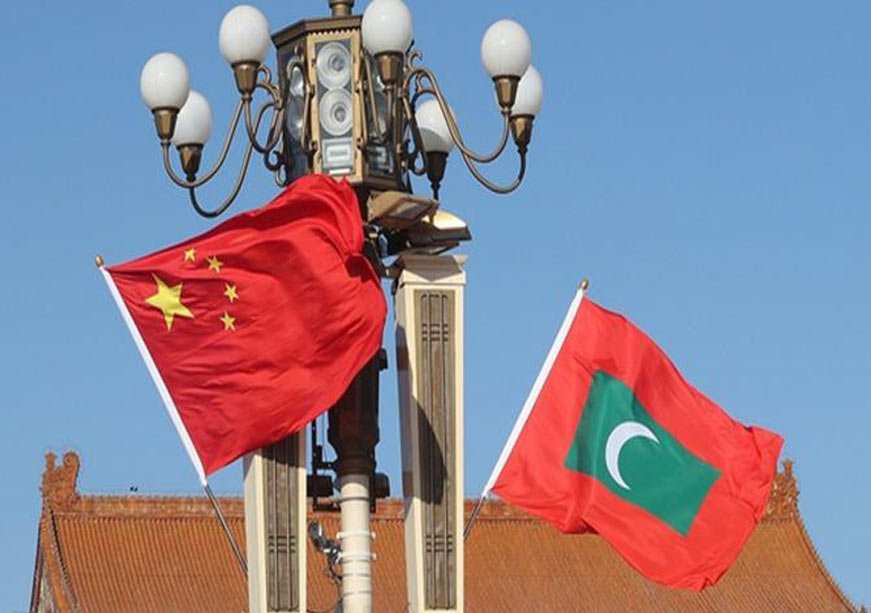
Debt restructuring, grants and donations, commercial contracts, and deepening trade and financial linkages are allowing China to enhance its presence in the Maldives and create economic dependencies.
On 30 November, the Maldivian government accelerated the Rasmalé project, a large-scale land reclamation initiative that will subsequently receive Chinese support for infrastructure development. This move underscores a broader shift in China’s economic presence in the Maldives under the presidency of Mohamed Muizzu. China’s modus operandi in the Maldives can be categorised into four broader trends: prioritising debt restructuring over new loans; focus on grants and donations; securing commercial contracts; and deepening economic and financial linkages. These engagements demonstrate that despite limited interest in offering new loans and funding mega-infrastructure projects, Beijing is enhancing its influence and creating long-term dependencies with the Maldives.
Debt Restructuring
Chinese presence and influence in the Maldives increased substantially under President Abdulla Yameen’s tenure (2013-2018). During this period, the government had borrowed significantly from China, estimated at around US$1.4 billion to 3.1 billion, in the form of loans and state guarantees for mega-infrastructure projects. By the time the COVID-19 pandemic hit the country, the succeeding administration of Ibrahim Solih had started servicing Chinese debts. When Mohamed Muizzu assumed office in November 2023, he inherited an economy marked by weak performance and high indebtedness. Drawing on his close ties with Beijing, Muizzu had sought debt restructuring and additional loans since taking office. Today, the Maldives’ debt exceeds 131 percent of its GDP.
Unlike earlier phases, when projects were financed, constructed, and in some cases operated by Chinese SOEs, current engagements are largely limited to construction. Project financing and operations are now being undertaken by the Maldivian government or third parties.
Beijing, however, declined to offer further loans. This could be for multiple reasons: China’s preference for small and beautiful projects over mega-infrastructure projects; the global slowdown of the Belt and Road Initiative; differences with ministers and relatively limited confidence in Muizzu and the Maldivian economy. Concerns of being affiliated with debt traps and losses incurred during debt restructuring in Sri Lanka also contributed to this decision. The then Chinese envoy also stated that debt restructuring could pose several difficulties for new loan-financed projects.
Inadvertently, much of China’s focus has been on debt restructuring. During Muizzu’s visit to Beijing in January 2024, the Chinese government agreed to provide debt relief, although the negotiations were prolonged. In the meantime, the depleting Chinese debt stock indicated that the Maldivian government continued servicing its loans. Table 1 highlights that approximately US$78 million of debt owed to key Chinese lenders was serviced between Q3 2023 (July-September) and Q3 2025 (July-September), in addition to China’s refinancing of US$75 million in September 2024. It was only in October 2025 that a bilateral debt‑relief arrangement was finalised. While the deal has not been made public, it builds on previous commitments and suggests a five-year deferral of Chinese debts, effectively shifting the debt-burden to the succeeding government.
Table 1: Maldives’ Debt Servicing

Source: Ministry of Finance and Planning
Grants and Donations
In the absence of new loans, China’s economic presence in the Maldives has been increasingly reinforced through grants and donations. In January 2024, Muizzu announced that China had pledged US$130 million in grant aid, the majority of which was used to develop roads in Malé and Villimalé. Figures from the 2025 budget indicate that China remains one of the leading sources of grants to the Maldives, even surpassing India in both 2023 and 2024. Furthermore, the 2025 budget forecasts that approximately 81% of bilateral grants in 2026 would come from China. This unusual estimate hints at the possibility of grants being processed under China’s broader debt restructuring efforts.
Over the last two years, Chinese grants and donations to the Maldives have increased significantly (see Table 2). This assistance is part of recent commitments, and MoUs signed between the two countries across sectors such as basic infrastructure, health, agriculture, defence, and sports. These initiatives not only enhance China’s physical presence and influence in the country but have also addressed essential needs of the island communities, generating goodwill among the people and delivering on Muizzu’s electoral promises. For instance, basic equipment, such as desalination plants, drinking water facilities, and stormwater pumps, is critical in addressing the Maldives’ consistent flood-related issues and water shortages.
Table 2: Chinese grants and donations

Source: Authors’ own
Securing Contracts
Additionally, several Chinese firms, especially state-owned entities, are involved in Maldivian projects as contractors (see Table 3). This data shows the expanding presence of Chinese SOEs, like China Machinery Engineering Corporation (CMEC), China Railway Construction Corporation (CRCC), and China Harbor Engineering Corporation (CHEC), in the Maldives. Unlike earlier phases, when projects were financed, constructed, and in some cases operated by Chinese SOEs, current engagements are largely limited to construction. Project financing and operations are now being undertaken by the Maldivian government or third parties.
Geopolitically, the presence of state-owned enterprises could also serve Beijing’s long-term interests, including physical presence, surveillance, business expansion and maintaining enduring links with local communities.
For the Maldivian government, Chinese contractors are easily accessible due to their historic and ideological ties with China. They also bring the potential for faster implementation and greater financial capacity. Parallely, for China and its SOEs, these contracts offer a commercial opportunity. Geopolitically, the presence of state-owned enterprises could also serve Beijing’s long-term interests, including physical presence, surveillance, business expansion and maintaining enduring links with local communities. Furthermore, the government’s inability to settle contractors’ bills owing to fiscal constraints may create new challenges, including the possibility of debt-to-equity swaps.
Table 3: Chinese contracting companies and projects

Source: Authors’ own
Trade and Financial Linkages
Trade and financial links between the two countries are also expanding. The China–Maldives free trade agreement (FTA), which came into force on 1 January 2025, promised to eliminate tariffs on a wide range of goods. However, the trade deficit, which had widened in recent years, has remained unchanged. Despite constant emphasis on a “mutual” partnership, Maldivian exports to China are negligible compared with imports. As Figure 2 shows, Maldivian exports have remained static and are significantly dwarfed by Chinese imports despite the implementation of the FTA.
Figure 2: Maldives-China Trade

Source: General Administration of Customs of the People’s Republic of China (till October 2025)
Financial ties between the two countries are growing, as the Maldivian government faces pressure on its depleting US dollar reserves in meeting its trade requirements and maturing domestic and external debts. In response, the People’s Bank of China and the Maldives’ central bank signed a memorandum of understanding (MoU) in September 2024 to facilitate trade in local currency. Maldivian banks have even permitted the opening of Chinese Yuan accounts, international transfers, and the issuance of letters of credit in Chinese currency, as well as the use of WeChat Pay. A Chinese bank has also expressed interest in opening a branch in the Maldives.
Geopolitically, the presence of state-owned enterprises could also serve Beijing’s long-term interests, including physical presence, surveillance, business expansion and maintaining enduring links with local communities.
These opportunities help facilitate further flow of currencies and trade, boosting tourism, trade, finance, and people-to-people ties. Maldivian importers can now source goods, especially construction materials and consumer products, directly in Yuan. The Maldives, however, will continue to face a shortage of Chinese Yuan owing to the large trade deficit. The government will therefore have to rely on a steady flow of Chinese tourists and loans, as well as Maldivian exports, to sustain its trade in yuan.
China’s engagement with the Maldives has strategically shifted toward smaller, impactful projects and deep economic integration. Its new approach—including loan restructuring, offering grants and donations, securing contracts, and promoting financial linkages—positions China as more than a creditor or investor. By shaping development opportunities, it creates dependencies that could complicate the Maldives’ efforts to diversify its economy and foreign policy in the coming years. Its growing influence will certainly pose new difficulties for India and the region in the future.