Pakistan’s military may prepare for war—but its economy is signalling collapse. A state cannot sustain conflict on the strength of power projection alone
Within 24 hours of India’s action on the Indus Water Treaty after the Pahalgam massacre, Pakistan scrambled to mount a counter-narrative. On April 24, Pakistani Prime Minister Shehbaz Sharif convened the National Security Committee, where India’s actions were called an act of war.
Pakistan declared the Simla Accord void and closed its airspace to India. The rhetoric is fiery, but beneath it lie unmistakable signs of deeper panic.
Diminishing Military Standing
These signs were immediately apparent just days later. After PM Modi granted the Armed Forces a “free hand” to respond to the Pahalgam massacre, Pakistan began bracing for a military strike within the next 24 to 36 hours. At 2 AM on April 30, its information minister claimed “credible intelligence” of imminent Indian action at an emergency press conference. Rawalpindi’s narrative is one of readiness and capability to match any Indian offensive. The Pakistani Senate had just days earlier unanimously rejected India’s accusations, invoking the 2019 Balakot standoff as proof of its ability to defend “sovereignty and territorial integrity”. Behind the bravado, the state of Pakistan’s military tells a more fractured story.
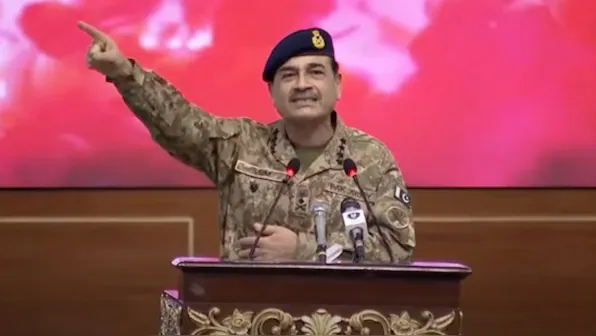
Reports suggest that General Munir’s leadership is being questioned from within the ranks. His speech at the Pakistani Overseas Convention, referring to Kashmir as Pakistan’s “jugular vein”, backfired. Open letters demanding Munir’s resignation, which accuse him of turning the Pakistan Army into “a firing squad for personal vendetta”, are going viral.