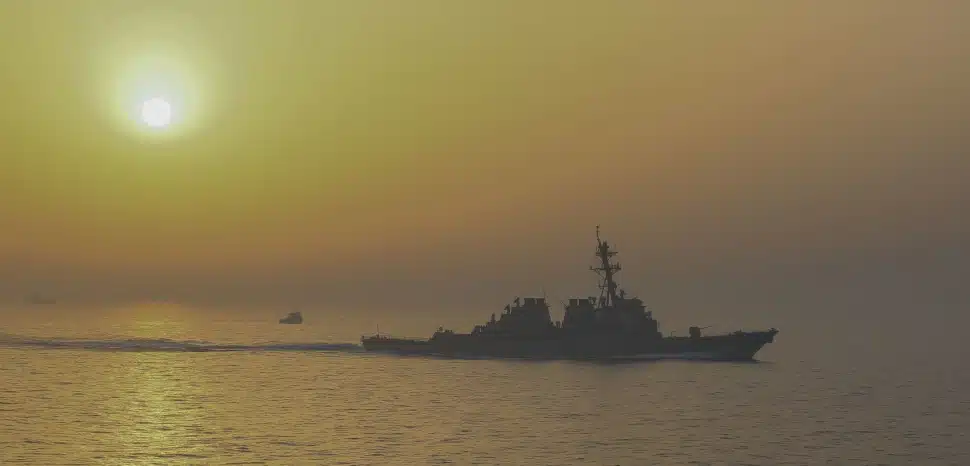
The Strait of Hormuz—a 33 km-wide choke point between Iran and the Arabian Peninsula—is arguably the most geopolitically sensitive maritime corridor in the world. Through this narrow waterway flows nearly a fifth of global crude oil production, a lifeline for global economic stability. However, the overwhelming strategic reality remains under-acknowledged: over 80% of oil passing through Hormuz is destined for Asia, and China alone accounts for one-third of the shipments. Given this disproportionate dependency, it is paradoxical that the burden of securing the strait still falls primarily on Western powers, particularly the United States.
In a changing global order marked by mounting geopolitical risk, it is time for Asia’s major powers—China, India, Japan, and South Korea—to assert more active diplomatic and military roles in securing the Strait of Hormuz. Failure to do so increasingly risks major economic shocks in the future.
Strait of Hormuz Lays Bare Asia’s Maritime Vulnerabilities
The Persian Gulf’s energy flows are of critical importance to the economies of Asia. The US EIA and Bloomberg’s 2023 data show that the flow of crude oil through Hormuz follows a clear pattern:
- China: 33% of energy shipments
- India: 13%
- Japan: 11%
- South Korea: 11%
- Other Asian states: 15%
These numbers suggest that more than four-fifths of the oil that goes through Hormuz is important to Asian economies. An interruption, even for a week, would not only raise energy costs around the world, but also halt supply chains, weaken industrial bases, and worsen geopolitical tensions across the region. Yet so far Asian governments have remained relatively quiet on the matter, belying the serious stakes involved.
Iran has used the threat of closing the Strait of Hormuz as a political weapon several times in the past, most recently when the Iranian parliament approved the closure of the Strait in retaliation to US strikes. Even though the US subsequently announced a truce between Iran and Israel, the situation remains fragile. Should it ever decide to move on these threats, Tehran has several options available, namely its navy, speedboat swarm tactics, anti-ship missiles in coastal batteries, and asymmetric maritime doctrine.
China, India, and Japan have relied on the US Navy Fifth Fleet, which is based in Bahrain, for protection. They have been able to take advantage of US-led stability without putting enough money into a multilateral security system or their own deterrence capabilities in the Gulf.
Yet this status quo is harder and harder to maintain. A global system with more than one pole, changing US strategic goals (for example, the shift to the Indo-Pacific in the last few years), and the stress of long-term naval deployments mean that regional and non-regional players must now take on more of the security burden.
China: From Silent Stakeholder to Strategic Actor
China’s oil dependence on the Gulf and its growing military presence in the Indian Ocean (for example, the Djibouti naval base and various anti-piracy operations) make it a de facto stakeholder in Gulf stability. But China has stayed out of Hormuz security issues directly because it wants to maintain good relations with Iran and avoid conflicts in the region. China’s response to the recent Red Sea shipping crisis and ongoing Houthi strikes was a reflection of this strategy.
But this approach no longer seems tenable. China needs to show that it is a responsible world power by clearly and credibly protecting its own energy corridors. Some options in this direction include joint patrols, sharing intelligence, or multilateral naval diplomacy.
India: Strategic Location, Strategic Delay
India has inherent advantages because its coastline faces west, its naval doctrine is strong, and it has been active in the Arabian Sea for a long time. Delhi has at times sent military ships to protect convoys and monitor for pirates, but remains hesitant to make its presence in the Gulf permanent due to concerns about escalation, regional sensitivities, and overstretch.
But this status quo is also in flux due to India’s growing energy requirements, stronger defense connections with the UAE and Saudi Arabia, and desire to have an impact outside the subcontinent – all of which lend themselves to a more proactive Gulf maritime strategy. The ambitious IMEC project also envisions a trade corridor linking India and the UAE, which makes it even more important for India to take part in regional naval operations and maritime security efforts.
Japan and South Korea: Big Economies, Lax Security
Even though Japan and South Korea are highly reliant on Gulf oil, they do not maintain a significant naval presence in the region. Japan has deployed forces to the Gulf for “information-gathering missions,” but its constitution limits what it can do. South Korea has also sent naval units to the Gulf from time to time.
Both countries need to move from symbolic deployments to real, coordinated missions, especially when it comes to mine countermeasures, convoy escorts, and collaborative logistics.
How Can Asia Pull Its Weight in the Gulf?
- Multilateral Maritime Security Mechanisms. Asian countries shouldn’t act alone; rather, they must set up new multilateral frameworks for marine domain awareness, coordinated naval presence, and crisis response. For example, Asian states could start a “Hormuz Maritime Stability Initiative” that would work alongside pre-existing Gulf cooperation mechanisms to supplement the US-led maritime security work that is already ongoing in the Arabian Gulf. The new initiative could set up cooperative patrols, intelligence-sharing hubs, and quick-response plans.
- Strategic Dialogue with Gulf States. Asian stakeholders should start a special strategic conversation platform with Gulf partners (Saudi Arabia, UAE, Oman, Bahrain) that focuses on energy security, naval cooperation, and stability in the region. This would add to their business relations by giving Gulf governments an option other than relying solely on existing security systems.
- Investing in Ports and Maritime Infrastructure. Setting up logistics hubs and naval access arrangements with Gulf and East African countries would provide additional options and allow for more extended deployments. India’s station in Duqm, Oman, and China’s presence in Djibouti are two early instances, although more varied agreements are needed.
- Finding a Balance between Diplomacy and Deterrence. Asia states and their Gulf partners should keep talking to Iran, but do so from a place of credible deterrence. Asian nations, especially China and India, can utilize their economic dominance over Iran to show that any meddling in the Strait of Hormuz will only make Tehran even more isolated. They can also provide powerful incentives for maritime de-escalation.
Putting Strategic Interests into Action
The states that rely the most on the Strait of Hormuz are also the ones least interested in keeping it safe. This is a geopolitical contradiction that cannot stand. The resulting strategic imbalance makes it more likely that Asia’s economic future will depend on Western forces and be exposed to the vagaries of regional instability.
China, India, Japan, and South Korea can’t afford to sit back and do nothing. It’s not simply a problem for the West anymore; it’s also a problem for Asia. If these countries want to preserve their energy supply chains, maintain peace in the region, and demonstrate that they are mature powers in terms of geopolitics, they need to stop acting diplomatically and start deploying a strategic naval presence, sharing security responsibilities with the Gulf and the West.