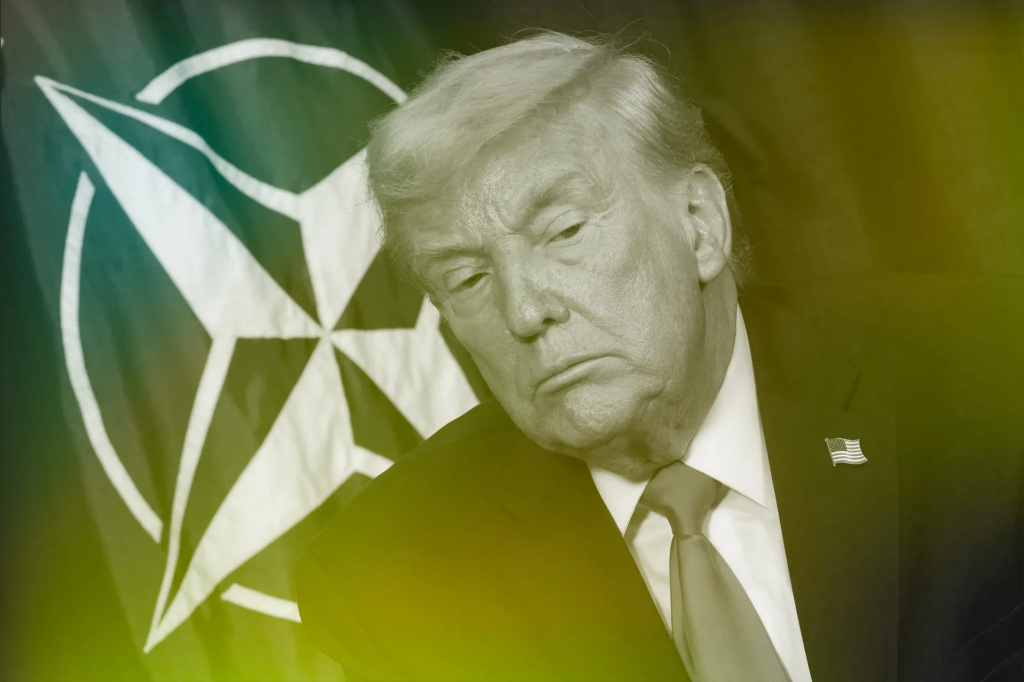
The President’s coercive policies, including his latest threats against Greenland, are prompting some foreign investors to think twice about parking their money with Uncle Sam.
t’s been a couple of weeks since Donald Trump and his cohort tried to bully the U.S.’s European allies into submission over Greenland, but the reverberations are still being felt. “There was a real sense that we were witnessing a moment of rupture,” Eswar Prasad, an economist at Cornell University and the Brookings Institution, who was attending the annual World Economic Forum, in Davos, Switzerland, when Trump flew in, recounted to me. “One thing that was clear to Europeans was that they can no longer trust the U.S. as a reliable ally on military security, economic security, or any other major matter.” The geostrategic implications of this realization are still coming into focus, as many governments around the world ponder the warning from Mark Carney, the Prime Minister of Canada, that “middle powers” need to come together in self-defense. In the financial markets, where things move faster, there has already been a dramatic reaction—one that has raised new questions about U.S. economic leadership and the dollar’s long-standing status as the dominant global currency.
After Trump vowed to impose tariffs on European countries that were resisting his claims to Greenland, the stock market plunged. The dollar fell, too. But shortly after arriving in Davos, he abruptly dropped his tariff threat and declared, on seemingly little basis, to have reached a “long-term deal” over the Arctic territory, and stocks quickly recovered most of their losses. Some observers hailed the President’s reversal as a repeat of last April, when he announced hefty tariffs on nearly a hundred countries, only to slash them a week later after investors puked. Whatever political chaos that Trump might be sowing, there is a pervasive sentiment on Wall Street that the markets will curb his most extreme impulses: as the saying coined by the Financial Times columnist Robert Armstrong goes, “Trump Always Chickens Out”—“TACO” for short.
But while the stock market, which is firmly in the grip of A.I. fever, rapidly shrugged off the Greenland crisis, the value of the dollar continued to decline: by last Thursday, it had fallen about three per cent. To the uninitiated, this might not sound like a big move, but the market for dollars is highly liquid—millions of transactions are taking place at any given time—and sudden price jumps are rare. During the run-up to Davos, there wasn’t any big news about G.D.P. growth, interest rates, or other economic factors that influence currency traders. “The only thing that is new is that the U.S. President issued a military threat against a NATO ally and threatened new tariffs on other U.S. allies that are also big creditor countries to the U.S.,” Brad Setser, a senior fellow of international economics at the Council on Foreign Relations, told me. “A capricious U.S. President played the key role in triggering this—he set it off.”
To be sure, the sudden drop in the dollar, by itself, “isn’t large enough to break anything,” as Setser put it. And on Friday the U.S. currency recovered some of its recent losses after Trump nominated Kevin Warsh, an experienced Republican banker, to replace Jerome Powell as the chair of the Federal Reserve. The market’s immediate reaction reflected a perception that Warsh is an inflation hawk and that his influence at the Fed could bolster the dollar. That remains to be seen, though. In auditioning for the job, he told Trump that he favored lower interest rates, which is what the President wanted to hear. If Warsh came to be regarded as a yes-man for Trump, that would be very negative for the dollar. More generally, the fear is that currency weakness could feed on itself if foreign investors lose faith in U.S. economic stewardship. Not only is Trump undermining NATO and using tariffs coercively, Prasad pointed out to me, but he has also spent twelve months attacking many of the domestic pillars of U.S. economic might, including the rule of law, the system of checks and balances, and the independence of the Fed.
For many decades, the U.S. dollar’s status as the dominant global currency was largely unchallenged. Foreign financial institutions and central banks built up large positions in U.S. financial assets, partly because they generated high returns and partly because they were widely viewed as a safe haven in an unsafe world. Right now, European countries are the biggest investors in America, holding an estimated eight trillion dollars in U.S. stocks and bonds. These investments help to finance the U.S. trade deficit and the U.S. budget deficit, both of which are very large. In the nineteen-sixties, Valéry Giscard d’Estaing, France’s finance minister (and subsequently its President), described the capacity of the United States government to attract large amounts of foreign money at low rates as an “exorbitant privilege” that enabled the country to live beyond its means. The privilege has endured. But, as Trump was issuing thinly veiled threats to invade Greenland, George Saravelos, the global head of foreign-exchange research at Deutsche Bank, Germany’s largest bank, suggested, in a note to clients, that these moves might make European investors less willing to accumulate U.S. financial assets and help America finance its dual deficits. “In an environment where the geoeconomic stability of the western alliance is being disrupted existentially, it is not clear why Europeans would be as willing to play this part,” Saravelos wrote.
For a country that has more than thirty trillion dollars of debt, and which ran a budget deficit of nearly $1.8 trillion last year, any indication that foreign investors may hesitate before buying more of its assets cannot be taken lightly. Treasury Secretary Scott Bessent, who was also in Davos, announced in an interview that the C.E.O. of Deutsche Bank, Christian Sewing, had called him to say that the bank, which has a large U.S. operation, didn’t stand by Saravelos’s report. But Saravelos himself hasn’t disowned his pessimistic analysis, and for good reason. Ultimately, the supremacy of the dollar rests on U.S. economic hegemony and trust in the American government, which Trump is busy eroding.
At this point, it’s not entirely clear who has been selling dollars. “The price action is consistent with European institutions reconsidering whether they want to keep adding to their U.S. assets,” Setser said. “It’s also consistent with fast money”—hedge funds and other speculators—“anticipating this trend and front-running it.” In the markets, betting against the dollar is known as the debasement trade. By early last week, the currency had fallen far enough for a political reporter to ask Trump, whether it had gone too far. “No, I think it’s great,” he replied. “The dollar’s doing great.” These comments prompted further selling, and the currency hit a four-year low. As often happens, Bessent was left to explain away his boss’s remarks. He appeared on CNBC the following day and insisted that “we have a strong dollar policy,” and argued that, over time, Trump’s tax cuts and tariffs would lead to more money coming into the United States and greater dollar strength.
Such an outcome isn’t inconceivable. Since the global financial crisis of 2007-09, the U.S. economy has grown faster than other major advanced economies; this has made it even more attractive to overseas investors. If, in the coming months and years, A.I. delivers the boost to G.D.P. and productivity which its promoters say it will, this U.S. outperformance could persist, or even quicken, and the dollar could rebound as Bessent predicted.
But a downward spiral also seems possible. Despite the assurances from Bessent, there is reason to believe that the Administration actually welcomes the devaluation of the dollar and would like to see it go further. A weaker currency would make U.S. exports, such as excavators manufactured by Caterpillar and turbines made by G.E. Vernova, more competitive abroad, which could help U.S. exporters and bring down the trade deficit. (The flip side is that Americans visiting London or Paris would find hotels and meals more expensive, and here at home the prices of imported goods, already impacted by tariffs, would go even higher.) Trump is clearly thinking along these lines. In his comments about the dollar, he noted how he used to “fight like hell” with China and Japan because they always wanted to devalue their currencies and gain a competitive advantage.
Some economists aligned with the President have openly questioned the logic of a strong currency. “The root of the economic imbalances lies in persistent dollar overvaluation,” Stephen Miran, who served as the chair of the White House’s Council of Economic Advisers until September of last year, wrote in a policy brief published shortly after the 2024 election. In that paper, Miran, who is now serving as a Fed governor on Trump’s appointment, also discussed some options to lower the trade deficit and resolve America’s debt problem. The most eye-catching one was to have some of the U.S.’s foreign creditors swap their short-dated Treasury bonds for very long-dated bonds that carry lower yields. “The apparent simplicity of this proposal contrasts with its devastating consequences, which would be a potential technical default on US Treasury bonds,” an analyst at Bruegel, a Brussels-based think tank with close ties to the European Union, noted last year. Any suggestion that the Trump Administration was seriously considering such a scheme could well send the dollar and the bond market into tailspins. So far, this specific proposal hasn’t gone anywhere, but with Trump seemingly intent on extracting bounties and tributes from foreign countries wherever he can, in the form of tariffs or other schemes, it would hardly be surprising if some people overseas were having second thoughts about parking their money with Uncle Sam.
Although some further weakness in the dollar wouldn’t necessarily be calamitous, so long as it was contained, any serious threat to its enduring role as a global means of exchange and store of value could have huge and unpredictable consequences. The main things still working in favor of the U.S. currency, and preventing a more drastic shift, are the relative strength of the American economy and the lack of suitable alternatives to U.S. assets, particularly Treasuries. Until late last week, gold and other precious metals had been soaring, but they don’t provide any yield, and they are famously volatile. Bitcoin’s boosters promote it as an alternative to the dollar, but during the past few months it’s been behaving like the opposite of a safe haven: since the start of October, its value has fallen by a third. Europe’s bond markets are still fragmented. China’s bond market is now the second largest in the world, but investing there involves substantial geopolitical risk. All this makes many large investors wary of abandoning the greenback. “If you have a few billion dollars to invest, you can easily find something other than dollar assets to diversify into,” Prasad said. “But, if you are managing tens of billions, or hundreds of billions, there is really nowhere else to go.”
This inertia likely means we haven’t reached the end of the dollar’s dominance or foreign demand for Treasuries. But Prasad, who recently published a book, “The Doom Loop,” about rising disorder in the global economy, believes the current policy trajectory—the Trump trajectory, that is—isn’t sustainable over the long term. “The U.S. government debt is still growing strongly with no apparent plan to contain it,” he said. “And the institutions that have underpinned the dollar’s dominance are being shredded before our eyes. All of this should be enough to bring down the dollar a few more pegs, if not demolish it altogether.”