Singapore is setting up a national space agency to anchor its next phase of growth in the global space economy.
The aim is to move beyond consuming space services and become “credible contributors to the global space ecosystem,” says Dr Tan See Leng, Minister for Manpower and Minister-in-charge of Energy and Science & Technology in the Ministry of Trade and Industry.
The National Space Agency of Singapore (NSAS) will be established on April 1, with Ngiam Le Na appointed as its founding chief executive. The agency will take over and expand the functions of the Economic Development Board’s Office for Space Technology and Industry (OSTin), providing what Tan describes as “decisive leadership to seize opportunities in the expanding space economy”.
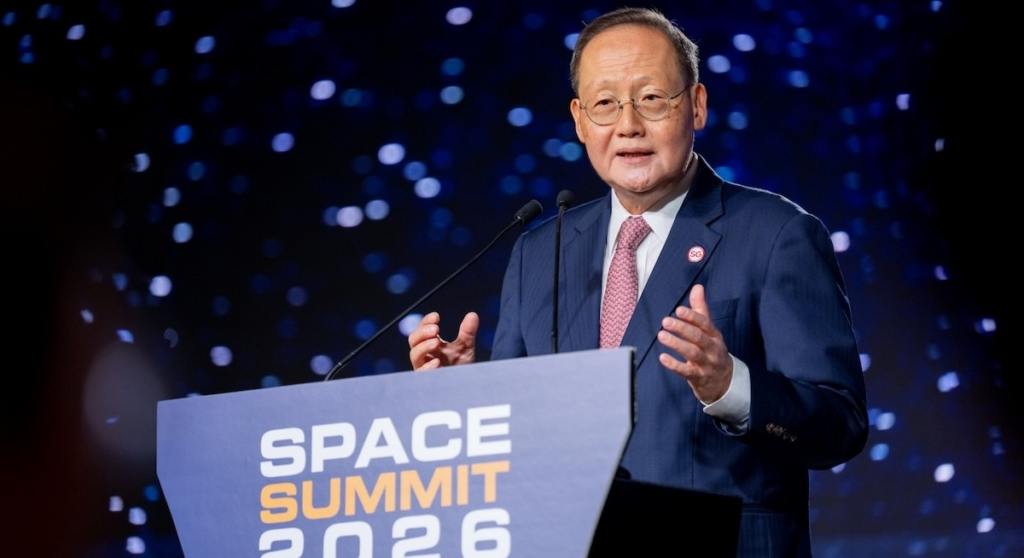
Speaking at the Space Summit 2026 in Singapore, Tan says the economics of space have changed dramatically, opening the field to smaller nations and businesses.
“The global space economy reached US$630 billion ($801 billion) in 2023 and is projected to soar to US$1.8 trillion by 2035. What was once the exclusive domain of the superpowers and aerospace giants has now become a more accessible frontier for nations and businesses worldwide,” he says.
For Singapore, space technologies already underpin core sectors of its open economy, including finance, maritime and aviation. Satellite systems enable global communications, navigation and earth observation, while advances in miniaturisation, artificial intelligence and falling launch costs are expanding what satellites can do and how often they can be deployed.
Tan says NSAS will be tasked with “building world-class space research and development capabilities, developing a thriving domestic space industry and advancing international partnerships”.
Since 2022, the Singapore government has committed more than $200 million to space research and development (R&D) projects under the Space Technology Development Programme, supporting research institutes and companies in developing and testing space technologies.
Looking ahead, Singapore will invest strategically in emerging areas such as climate and sustainability technologies, including satellite remote sensing and carbon monitoring; space sustainability technologies such as space situational awareness and debris mitigation; and microgravity research to advance human health sciences.
Beyond funding and research, NSAS will play a direct role in helping Singapore-based companies grow beyond the domestic market.
“We will also continue to anchor space technology companies in Singapore and help them capture regional growth opportunities,” says Tan, pointing to the city-state’s role as a trusted and connected hub with strong finance and logistics capabilities.
Singapore is also seeking to strengthen the industrial foundations supporting space activity. Tan shares that NSAS will work to develop a robust ecosystem of component manufacturers and facilities for assembly, integration and testing to accelerate the development of space-based systems by local players. The effort builds on Singapore’s existing strengths in adjacent sectors such as aerospace, microelectronics and precision engineering.
Local companies are already positioning for that next phase. At the same summit, ST Engineering announced new satellite and geospatial programmes aimed at expanding its presence across earth observation, communications and space operations.
Additionally, NSAS will take on new national functions. It will develop and operate Singapore’s national space capabilities, including a multi-agency operations centre to support government agencies with satellite tasking and bespoke geospatial data analytics. The government currently co-owns three earth observation satellites with ST Engineering. Applications include port operations, urban planning, environmental monitoring and food security.
As activity in orbit intensifies, regulation is becoming increasingly important. NSAS will therefore be responsible for developing legislation and regulations for Singapore’s space sector, building on guidelines introduced in 2024 covering the registration of space objects and requirements for safety and sustainability.
“NSAS will be pro-innovation and pro-business while meeting high standards for space safety and space sustainability,” says Tan.
Singapore will also expand its international partnerships, including deeper collaboration across the equatorial region, where earth observation data can be tailored to local environmental and economic needs. The agency will strengthen ties with emerging space nations within Asean and globally, particularly on issues related to the long-term sustainability of outer space.
“Our optimism is grounded in purpose. We want to translate innovation into real solutions that strengthen our economy, improve lives and address global challenges with precision and foresight,” says Tan.