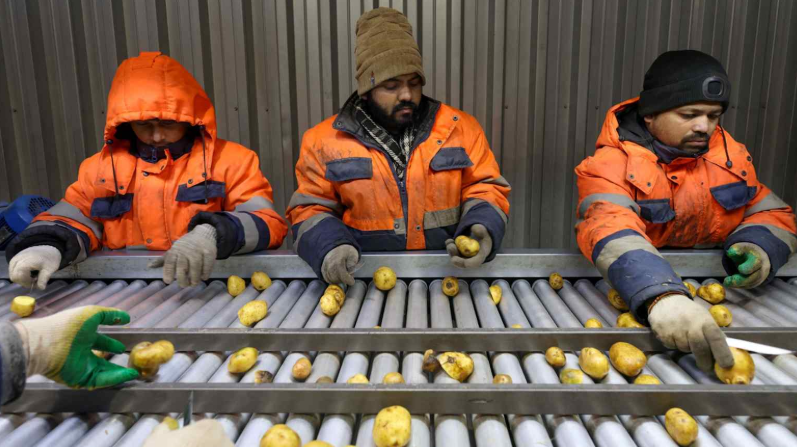
Russia and Ukraine increasingly rely on immigrant workers, particularly from Global South countries such as India, to fill the holes in their labor forces left by troop deployments.
Russia issued about 240,000 work permits to foreigners requiring visas last year, the Ministry of Internal Affairs reports, up 150% from 2021, before Moscow launched its full-scale invasion of Ukraine.
India was the second-largest source of workers behind China with 56,000 permits issued, up tenfold from 2021. Bangladesh and Sri Lanka each accounted for fewer than 10,000 permits, but their numbers swelled by roughly 400 times and nearly seven times, respectively, from 2021.
Russia and India agreed in December to simplify procedures for temporary workers. Moscow plans to accept more than 70,000 Indian workers per year.
Indian staffing agencies are hiring for an array of openings at Russian companies, ranging from auto mechanics to IT engineers to farmworkers, in Moscow and smaller cities.

India’s Ambe International began connecting workers with jobs in Russia last year and expects demand from businesses there to keep rising. Many Russian companies see India’s youthful talent pool as highly adaptable and cost-effective, a representative said.
Migrant workers from India are cleaning streets and removing snow in the major northwestern city of St. Petersburg, Russian outlet Fontanka has reported. These workers are paid nearly 100,000 rubles ($1,300) per month, along with room and board, and can take Russian language lessons, the outlet said.
Ukraine issued more than 7,000 work permits to foreign nationals last year, up around 15% from 2024. It is eyeing South Asian countries such as India and Nepal, as well as Latin America. Short-staffed construction sites increasingly rely on South Asian workers.
 A square in central Kyiv houses flags memorializing Ukrainian soldiers killed in the war with Russia. (Photo by Natsuki Kaneko)
Kyiv is rushing to catch up with Moscow’s recruitment efforts. Legislation to streamline procedures for temporary residence and work permits has been submitted to Ukraine’s parliament, with deliberations expected soon.
Outsourcing company Gowork last year began helping Ukrainian businesses recruit Indian and Nepalese workers, handling the paperwork and interviews. In addition to construction and transportation, the company is preparing to dispatch agricultural workers this year, Gowork executive Dmytro Vlakhov said.
Both Russia and Ukraine are grappling with labor shortages. Russia’s unemployment rate has sunk from over 4% before the invasion to a historic low of 2.2% as more troops have been sent to fight in the conflict.

Anton Kotyakov, Russia’s minister of labor and social protection, said in December that the country needs to gain 1.7 million workers per year, Russian news agency Tass reported.
Ukraine faces an estimated shortfall of 4.5 million workers over the next 10 years, with shortages of around 40% in construction and medical services.
Russia’s recruitment of foreign workers has raised concerns, including allegations from Asian and African countries that workers have been tricked into being sent to the front lines of the war under the guise of job training.
India’s External Affairs Ministry said in December that 202 Indian nationals were confirmed as having been recruited into the Russian military. While most had been discharged, 26 were killed and seven were missing, the ministry said.
Kenya reported this month that more than 1,000 of its citizens had been recruited into the Russian military.