Asia

Copper Breaks $10,000 Due to US Economic Strength and China Stimulus
Asia, China, Market

Copper Breaks $10,000 Due to US Economic Strength and China Stimulus

(Bloomberg) -- Copper rallied back above $10,000 a ton and iron ore broke through $100 after China’s top leaders stepped up efforts to revive economic growth for the world’s largest metals consumer. The price of copper rose more than 2% to a three-month high on the London Metal Exchange after the official Xinhua News Agency reported that China’s Politburo will push for the real estate market “to stop declining” and called for “forceful” rate cuts. That followed a Bloomberg report that China is considering a $142 billion capital injection into the biggest state banks. “They’re trying to restore confidence in their economy,” said Michael Cuoco, head of metals at StoneX Financial Inc. “They’re sending a message to their populace that they understand that there are problems and hardship...
China boosts markets by promising to provide further economic help.
Asia, China, Market

China boosts markets by promising to provide further economic help.

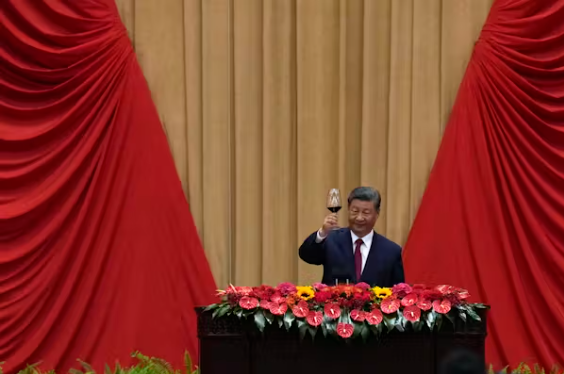
China’s leaders have vowed to intensify fiscal support for the world’s second-largest economy, fuelling markets with hopes of more intervention just days after the central bank announced the biggest monetary stimulus since the pandemic. The politburo, led by President Xi Jinping, pledged on Thursday to “issue and use” government bonds to better implement “the driving role of government investment”, in comments that come as analysts warn that China is in danger of missing its official economic growth target this year. The politburo usually does not hold economic sessions in September, suggesting “an increased sense of urgency” about growing deflationary pressures, Morgan Stanley analysts said. But they said China’s government did not yet appear to have reached a “whatever it takes” moment ...
Anti-China EV Laws Won’t Keep America Safe Indefinitely
Asia, China, USA, World

Anti-China EV Laws Won’t Keep America Safe Indefinitely

You may look at the auto industry's current chaos in Europe and think that those problems won't come to America. That this country is now taking aggressive steps to protect its auto market with 100% tariffs on Chinese-made EVs or a software ban that will effectively prohibit those cars from being sold here entirely. From that, you may think that it's all problem solved—the U.S. keeps new players from China out for good. But the truth is that these protectionist measures are temporary at best, and even the auto industry seems to get it. Or at least, the smart folks in the business do.  That leads off this midweek edition of Critical Materials, our morning roundup of tech and industry news. Also on tap today: Hyundai's online sales program with ...
Through negotiations on minimum EV pricing, China and the EU want to avert a trade war.
Asia, China, Market

Through negotiations on minimum EV pricing, China and the EU want to avert a trade war.

BERLIN — Brussels and Beijing are engaged in intense 11th-hour negotiations on Chinese electric-vehicle subsidies, raising hopes in Germany that EU duties — and a wider trade war — can still be avoided, officials familiar with the talks said. The discussions are an attempt to solve an ongoing dispute over Beijing’s subsidies for Made-in-China EVs, which the EU says are artificially lowering prices and making it impossible for its own industry to compete. Under discussion is the idea of setting voluntary minimum prices that would offset the market-distorting Chinese subsidies, thereby rendering the planned EU duties moot. One official described the concept as a “surcharge“ that would balance out the Chinese state aid. A meeting between Chinese Commerce Minister Wang Wentao an...
Since the epidemic, China’s central bank has unveiled the most powerful stimulus.
Asia, China, Market

Since the epidemic, China’s central bank has unveiled the most powerful stimulus.

BEIJING, Sept 24 (Reuters) - China's central bank on Tuesday unveiled its biggest stimulus since the pandemic to pull the economy out of its deflationary funk and back towards the government's growth target, but analysts warned more fiscal help was vital to hit these goals. The broader-than-expected package offering more funding and interest rate cuts marks the latest attempt by policymakers to restore confidence in the world's second-largest economy after a slew of disappointing data raised concerns of a prolonged structural slowdown. But analysts questioned how productive the People's Bank of China's liquidity injections would be, given extremely weak credit demand from businesses and consumers, and noted the absence of any policies aimed at supporting real economic acti...
Asia, China, Market, World

The world economy is stabilizing, but it is still weak. These are the main economists’ predictions for the economy.

The global economic outlook is stabilizing amid continuing economic uncertainty. The World Economic Forum's September 2024 Chief Economists Outlook found that a majority of chief economists (54%) expect the condition of the global economy to remain unchanged over the next year while more than a third (37%) expect it to weaken. “There are reasons for cautious optimism such as an easing of inflation and evidence of the resilience of global commerce,” the report notes. “Yet, if the economy is stabilizing, it is doing so at the weakest level in decades.” The Chief Economists Outlook, published three times a year, surveys leading chief economists from across industries and international organizations. The latest edition explores key trends in the global economy, includi...
There is a local government issue with Xi’s property correction.
Asia

There is a local government issue with Xi’s property correction.

Xi Jinping’s most audacious attempt to revive China’s property crisis is running into an unexpected roadblock: local government leaders who seem not to have gotten the memo. Headlines surrounding the efforts announced four months ago focused on 300 billion yuan (US$42.5 billion) of central bank cash being deployed to buy up unsold homes. But the real thrust of the scheme was prodding local authorities to hoover up excess housing supply by far greater amounts around the nation. So far, though, fewer than 30 mainland cities out of the more than 200 Beijing hoped to incentivize have heeded the call. This raises a tantalizing question: Are municipal officials being delinquent, or is their inaction because they see a bigger picture that Xi’s team is missing?
How China got to be the market leader for electric vehicles and what the US can do to catch up
Asia, China, Market

How China got to be the market leader for electric vehicles and what the US can do to catch up

The U.S. blinked, and China built an electric vehicle empire. "They're taking over the world, except North America," said Lei Xing, a Chinese auto industry expert. "The U.S. will be the last frontier." In the last 15 years, China has rolled out a public charging network over 10 million strong, convinced billions of drivers to go electric by dangling subsidies and other incentives, and introduced over 100 EV brands with a bevy of pricing options. The push exemplifies "China Speed," a term Xing used to describe the country's hypersonic development. The speed and scale of the shift has slingshotted China past the U.S. and every other nation in the transition to electric vehicles, while also positioning Chinese automakers near the front of the pack to dominat...
China Is Not Rich, But It Has Become Powerful
Asia, China

China Is Not Rich, But It Has Become Powerful

On Aug. 22, China commemorated the 120th anniversary of the birth of former Chinese leader Deng Xiaoping, whose market reforms catapulted China from famine-stricken communist backwater to global economic power. Xi praised Deng for his contribution to the party and the nation. Despite the two leaders’ common goal of a powerful China, however, Xi’s strategy for achieving it markedly differs from Deng’s. By extending his reign as China’s paramount leader beyond the two-term limit favored by Deng and making no preparations for a transition of power during his lifetime, Xi has discarded one of Deng’s main ideas for ensuring long-term political stability. Whereas Deng emphasized market reforms, Xi is reasserting centralized control by the party-state. But the most remarkable change ha...
Asia, Market, World

Rate increases will persist even when the Bank of Japan fires in September.

What’s happened? The Bank of Japan (BOJ, the central bank) decided to keep its policy rate unchanged at 0.25% at its policy board meeting on September 20th, pausing after a 15-basis-point increase in July. On the same day, official data showed that headline consumer price inflation accelerated to a 10-month high of 3% in August, from 2.8% in July, following strong growth in prices for food and utilities. Why does it matter? The BOJ is determined to pursue monetary normalisation by raising interest rates and winding down its asset-purchase programmes. However, the pace of the policy shift and the terminal policy rate will depend on Japan’s economic fundamentals, notably the strength of private demand and inflation expectations. The pause in September was factored into EIU’s foreca...