Asia

Asia

Sri Lanka’s economy shrank 3.1% in second quarter amid financial crisis

Sri Lanka's economy shrank 3.1% in the April-June quarter, official data showed on Friday, as the country struggles to claw out of its worst financial crisis in decades. The downturn was driven by high inflation, a depreciating currency and lower purchasing power, the Census and Statistics Department said in a statement. The agriculture sector grew 3.6% from a year earlier, but output from industries contracted 11.5% and services dropped 0.8%, the department said. ri Lanka's central bank projects that gross domestic product (GDP) will shrink by 2% this year, having contracted 7.8% in 2022, after the island's economy fell into a severe foreign exchange crisis that decimated growth. The economy contracted 11.5% in the first three months of this year but activity has gradually st...
Asia

Pakistan’s national carrier forced to ground aircraft amid severe financial crisis

As it struggles to secure funds to maintain its operations, Pakistan International Airlines (PIA) has reportedly resorted to grounding several aircraft.  Dawn reports that over the next few months, PIA's core functions and non-core assets are expected to be put up for sale. Just last week, Pakistan's Ministry of Aviation issued a stern warning and told the federal government that the airline is grappling with a severe cash flow crisis.  This, the ministry said, has led to arrears with creditors, aircraft lessors, fuel suppliers, insurers, international and domestic airport operators, and even the International Air Transport Association (IATA). Also read | 'Landmine' explosion in Pakistan's Peshawar injures 11, one FC personnel killed Due to this, Pakistan's n...
China’s Central Bank Ramps Up Bulk Dollar Deal Scrutiny
Asia

China’s Central Bank Ramps Up Bulk Dollar Deal Scrutiny

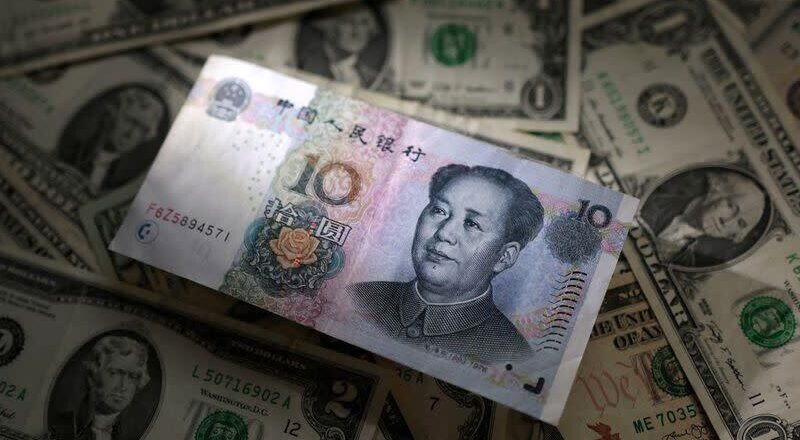
The Chinese yuan has fallen by about 6% against the US dollar so far this year, a level not seen since the 2008 global financial crisis China’s central bank has been forced to tighten its control of bulk dollar purchases by domestic firms, as the Chinese currency faces mounting pressure after falling to levels last seen 15 years ago. Companies that need to purchase $50 million or more will now need approval from the People’s Bank of China (PBOC), which convened a meeting with some commercial banks over the weekend on the matter, sources said on Monday. “The approval process will be extended,” said one of the sources. “The recent yuan depreciation has indeed been too severe and many now expect the yuan to weaken beyond 7.5 per dollar.” The central bank has warned some lenders o...
Did Authoritarianism Lead to the Economic Crisis in China?
Asia

Did Authoritarianism Lead to the Economic Crisis in China?

An erosion of trust between the government and its people now threatens the country’s decades-long boom. China’s economy, the world’s second largest, is facing its most serious setback in a generation. During the past two years, economic growth appears to have been cut nearly in half. After emerging from the “zero covid” policies that Xi Jinping, China’s leader, ordered early in the pandemic, the country now faces a real-estate crisis and faltering confidence from both its own citizens and overseas businesses. The problems have sparked debate among economists about whether Xi’s increasingly autocratic regime is to blame, and what a major slowdown could mean for the rest of the world. To talk about China’s economy and the possible causes of its malaise, I recently spoke by phone with...
Asia

The Promise and Peril of Pakistan’s Economic Recovery Effort

Pakistan’s risk of defaulting has receded for now, but it needs more help from the IMF and foreign benefactors for a sustainable economic recovery. In the first half of 2023, Pakistan appeared to be moving toward a catastrophic economic default. An IMF loan program Pakistan entered into in 2019 had gone off track after the Fund found Islamabad’s commitment to reform lacking, leading to a suspension of loan disbursements. The derailment of the IMF program resulted in a significant drop in the country’s foreign exchange reserves — at one point this year, reserves could only cover about two weeks' worth of imports due to concurrent debt repayment pressure. To avoid defaulting, the government imposed stringent import restrictions in an attempt to control dollar outflows. That caused a majo...
Did Authoritarianism Cause China’s Economic Crisis?
Asia

Did Authoritarianism Cause China’s Economic Crisis?

China’s economy, the world’s second largest, is facing its most serious setback in a generation. During the past two years, economic growth appears to have been cut nearly in half. After emerging from the “zero covid” policies that Xi Jinping, China’s leader, ordered early in the pandemic, the country now faces a real-estate crisis and faltering confidence from both its own citizens and overseas businesses. The problems have sparked debate among economists about whether Xi’s increasingly autocratic regime is to blame, and what a major slowdown could mean for the rest of the world. To talk about China’s economy and the possible causes of its malaise, I recently spoke by phone with the economist Eswar Prasad: a professor at Cornell University and a senior fellow at the Brookings Institut...
Asia

How a Country’s Debt Crisis Can Affect Economies Around the World

Whether in the private sector or government, a debt crisis in one country can and frequently does spread economic pain to other countries. This can happen through a tightening of financial conditions such as a spike in interest rates, a slowdown in trade and economic growth, or merely a steep decline in consumer confidence. This is especially true if the country in crisis is large and intricately linked to the global economy. KEY TAKEAWAYSDebt crises in single nations can affect the economies and people of other countries.Countries can experience financial losses, market turmoil, and sharp slowdowns in trade and economic growth.Even in a small country, a debt crisis can have devastating effects elsewhere if that country is enmeshed in the global financial system and economy.The g...
Asia

China’s Property Market on the cusp of collapse?

China’s Evergrande Group, once China’s second-largest property developer has filed for bankruptcy in the US. Chapter 15 bankruptcy protection, allows a US bankruptcy court to step in when an insolvency case involves another country. It is intended to help promote cooperation between US courts, debtors, and other countries’ courts involved in cross-border bankruptcy proceedings. Evergrande, the beleaguered firm, borrowed heavily and defaulted on its debt in 2021, sparking a massive property crisis in China’s economy, which continues till date. The company’s bankruptcy serves as a cautionary lesson about ‘growth-at-all-costs’’ model that underpinned China’s spectacular growth in the past three decades. The company’s default came after Beijing began cracking down, two years ago, on...
Asia is affected by the recession in China’s economy.
Asia, China, World

Asia is affected by the recession in China’s economy.

China’s slowing growth is sparking warnings of contagion in Asia, as waning consumer demand and slower manufacturing hit neighbouring countries with close ties to the world’s second-largest economy. A manufacturing slump in South Korea has extended to its longest in nearly half a century while other big exporters in east Asia area also being hit by slow demand. South Korea, Asia’s fourth-biggest economy, is viewed as a bellwether for the region’s technology supply chain, which has helped underpin global growth for decades. The country’s exports fell in July at the steepest pace in more than three years, led by smaller shipments of computer chips to China, while purchasing managers’ indices on Friday showed that factory activity fell in August for the 14th consecutive month, the l...
China halts release of youth unemployment data amid faltering economy
Asia, China

China halts release of youth unemployment data amid faltering economy

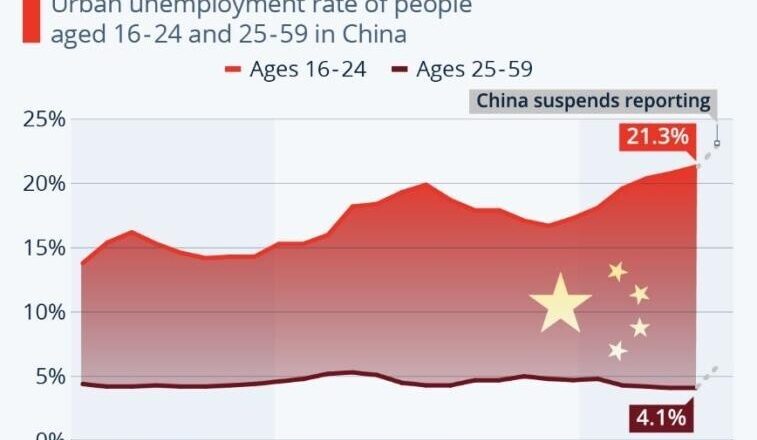
After the number of its unemployed youth went on increasing for six consecutive months, the Chinese government suspended the release of unemployment data in August. The share of unemployed people between 16 and 24 years of age in urban areas rose every month of 2023, reaching a whopping 21.3 percent in June. This is the highest recorded figure since the data was first published in 2018. No timeline has been announced for the suspension. Explaining the move, Fu Linghui, a National Bureau of Statistics (NBS) spokesman, said the surveys used to collect the data needed to be improved and optimised. There is also a debate about whether students seeking employment before graduation should be included in labour force surveys and statistics. Many, however, opine that these are just excuses and...